
I have a fix for all your bass recording / mixing issues. It involves two Korneff plugins and it’s easy and fast and I’ll give you the ENTIRE RECIPE. And a discount on the two plugins.
But first, allow me to bore you with why bass is such a pain in the ass to record and mix.
Bass = Ass – B
I have no idea what that means, but in the 90s I was working with a band, and Charlie the guitar player, when something didn’t sound right he would say, “This sounds like ass.” I love that phrase. Hats off to Charlie, who was and still is an amazing guitarist and musician.
Electric and acoustic (upright) bass… damn, these are difficult to record well. And it gets worse when you don’t have a great player or you’re dealing with an inferior instrument.
Basses tend to be unpredictably resonant, with notes that jump out or are too quiet all over the neck, especially cheaper instruments. Sometimes—uh, I mean often—the low notes are much louder than the high notes, and the registers across the instrument aren’t balanced. Bass cabinets tend to be resonant and very picky when it comes to mic placement, and low frequencies always involve the room’s acoustics in some way.
Basses are super sensitive to the player’s technique. A good player can do a lot to even out the dynamics across the instrument such that the output is consistent and the low register is similar in tone and loudness to the middle and upper registers. An inexperienced player without the technical chops is incredibly frustrating to record. I used to dread punching in some bass players, because even with serial compression they were all over the place in terms of tone and level.
Speaking of compression, I know a bunch of you are tracking bass straight into your interface with nothing more than a cable. YOW! That is DIFFICULT. My usual bass input chain had $4000 worth of preamps and compressors in it and still there were times—pretty often actually—where the bass was a pain in the mix. If this is your situation, I feel for ya. And what I’m going to show you is life changing.
Here’s a grab from the Analyzer on our Dual Level Compressor 2, of a bass part that was a bitch and a half to mix. There’s a 20dB swing in terms of volume. That is INSANE. That’s moving from way too f**king loud to “Lars, get your hands off the mix” note by note by note.
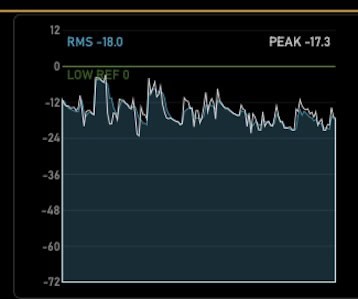
Of course, you get a great player like Tal Wilkenfeld and tracking bass is a piece of cake. I had the pleasure of recording Bowie’s bassist on his last record, Tim Lefebvre, early in Tim’s career and I didn’t even compress it going to tape, he was so fricken’ consistent. A half-an-hour session, three takes and Tim heads home on the subway. But how often does that happen?
In the mix, bass is a hard instrument because it shows up so differently depending on the speakers. It can sound great and present on big speakers and then vanish on small speakers. You can get it to sound present and clear on small speakers and then it sounds midrangy and honky on big speakers. You can have perfect bass on the car ride home and then you get a phone call from the band and they’re pissed because it’s too quiet on the singer’s stereo and too loud for the drummer and the bassist wants to recut the part.
Often it isn’t that the lows aren’t loud enough. Little speakers generally can’t even reproduce the fundamentals for many bass notes, they’re just too low for the speaker anyway and they never had a shot at being able to play them back. The issue is that there aren’t enough overtones present such that your ear can invent the fundamental from the overtones.
I hope you know that—that most of the bass notes you hear are your brain inventing them from overtones. It’s like how the smell of food gives you the taste of it. Pinch your nose and eat a piece of basil and your brain will think, “Is this a leaf or a chunk of plastic?”
Finally, bass is INCREDIBLY IMPORTANT on a record, and I’m not even talking about spectacular basslines. Think of the whole London Calling album without bass on it. Think of U2 records with no bass. Imagine Van Halen records without Michael Anthony doing the simple things he does. The groove falls apart without bass.
You can’t have sucky bass on a record. Here’s the fix.
Dual Level Compressor 2 kicks ass
Get your bass track up. Make sure if you’ve got multiple inputs on it—a DI and a mic’d cabinet—that you have the phase lined up. I usually bus all the bass tracks together and then put the Dual Level Compressor 2 on the bus’s channel.
Run the recording, and try to find a position for the bus fader such that the bass usually makes sense in the mix—not WAY too loud or WAY too quiet, but maybe occasionally stupidly loud or quiet.
Slide up the LOW LEVEL fader so that the green BOOST LEDs start to ladder up. There will come a point where suddenly, the low notes aren’t vanishing and the bass is somehow “there.” It still might sound like ass, but at least we can see the ass. Hear the ass, rather.
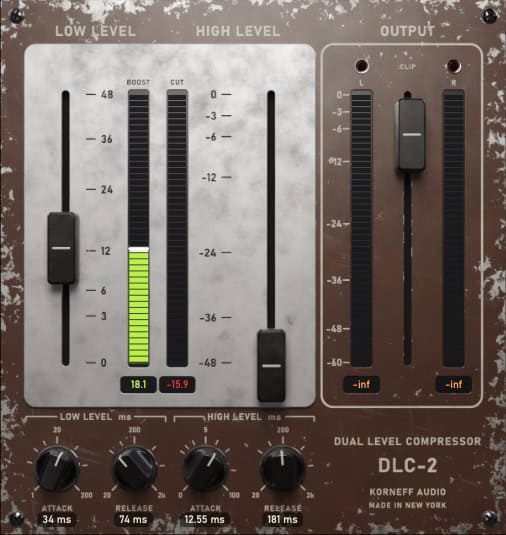
Now, pull down the HIGH LEVEL fader such that the red CUT LEDs start to ladder down—hitting on the loud notes. Tweak the OUTPUT fader so that you are not clipping! The red lights shouldn’t go on. Pull the fader down. And feel free to leave some headroom up there. Everyone is so hung up on headroom headroom headroom. You’re recording digitally. You have TONS of headroom and dynamic range. You’re not on analog tape.
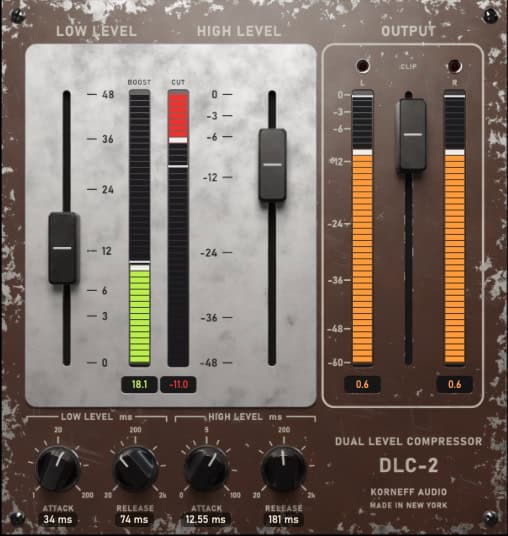
Seat the bass to where you think it needs to be. I usually adjust my releases and attacks to bring out as much clarity and click on the bass as possible. I turn off the LOOK AHEAD to eke out a bit more punch. My settings are in the diagram above, but you’ll have to mess with things.
I swear, the DLC-2 is a miracle. It works SO WELL FOR THIS.
Levels fixed, or at least a lot better… time to tackle the tone issues.
Chocolate Milk kicks ass
After the DLC-2, put an instance of the Chocolate Milk on the channel. Incidentally, Korneff Audio also makes the Chocolate Milk.
Chocolate Milk is supposed to be a tape saturation emulator. We call it a “gooderizer,” because whatever you put it on tends to sound gooder. It’s great on bass.
Why? Why is tape saturation nice for bass?
Because tape saturation involves magnetism, and if you overload magnets, like transformers and tape particles (they are little magnets), you generate overtones—upper harmonics—and because of the physics involved, overloading magnets is a good thing for overtones from low frequencies.
But WHENEVER YOU SATURATE SOMETHING YOU CLIP TRANSIENTS. So, tape is nice because it has saturation, and then it sucks because if you hit it hard and get saturation, you’re clipping transients. So you get more overtones and less clarity and punch. It’s a trade-off. But not with Chocolate Milk.
The Milk splits things into three frequency bands: Lows, Mids and Highs. The saturation is added to the Low band, which is where ya want that saturation coming from, but it doesn’t saturate the mids or the highs, which is where all the clarity and high frequencies are. So, thanks to the genius of Dan Korneff (and I mean the genius part sincerely), Chocolate Milk gives you saturation AND punch. And… we stuck a compressor on the midrange so you can get even MORE punch if you need it.
SO… Chocolate Milk goes after the Dual Level Compressor 2. Click the nameplate and go right around to the back. Bring up the PURPLE TRIANGLE, which is the control called MOO, which is saturation. Bring it up ’til the bass jumps out a bit and there’s an increase in clarity. Extra points if you do this on a small speaker.
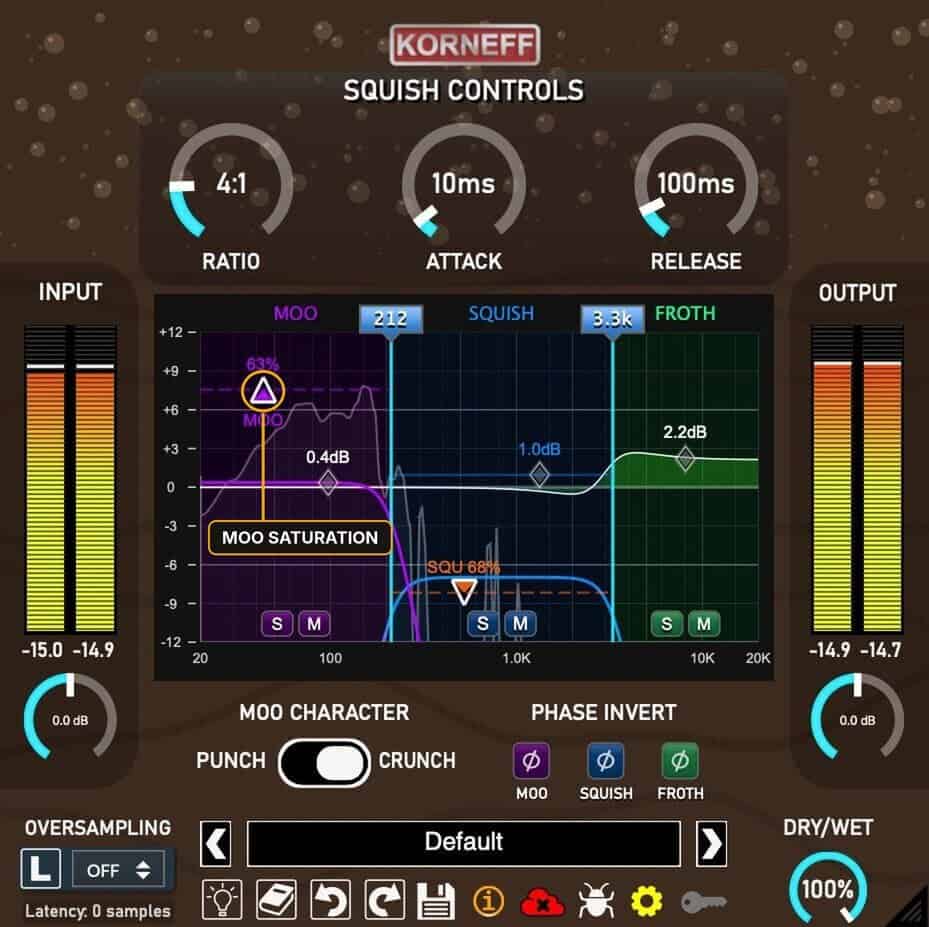
The center, in blue, is SQUISH, and that’s compression. You can pull the ORANGE TRIANGLE down a bit—that is compressor threshold. You can tweak the ratio, attack and release. In my example settings it is all pretty fast. I’m using it more as a wimpy limiter to catch some of the really loud stuff that’s getting past the DLC-2.
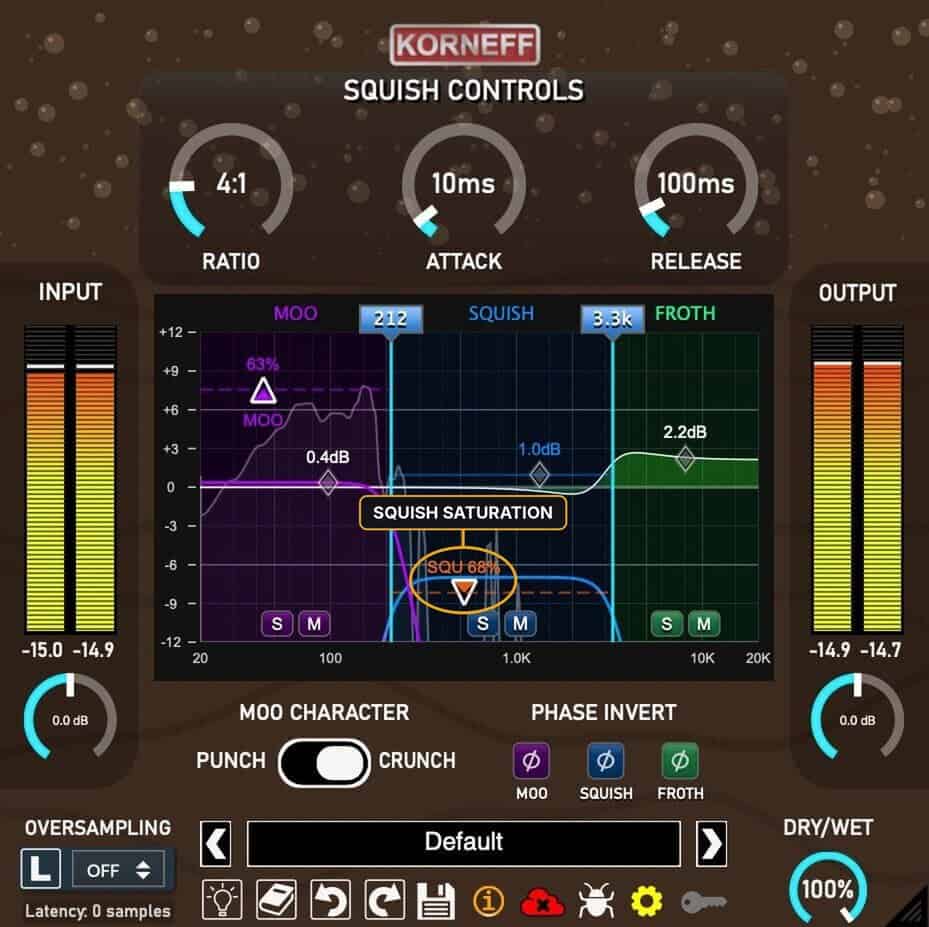
NOW… think of the Chocolate Milk as a three band EQ. MOO, SQUISH and FROTH are each a band, from lows to highs. And there are two blue crossover controls. This is where the magic of this thing lives.
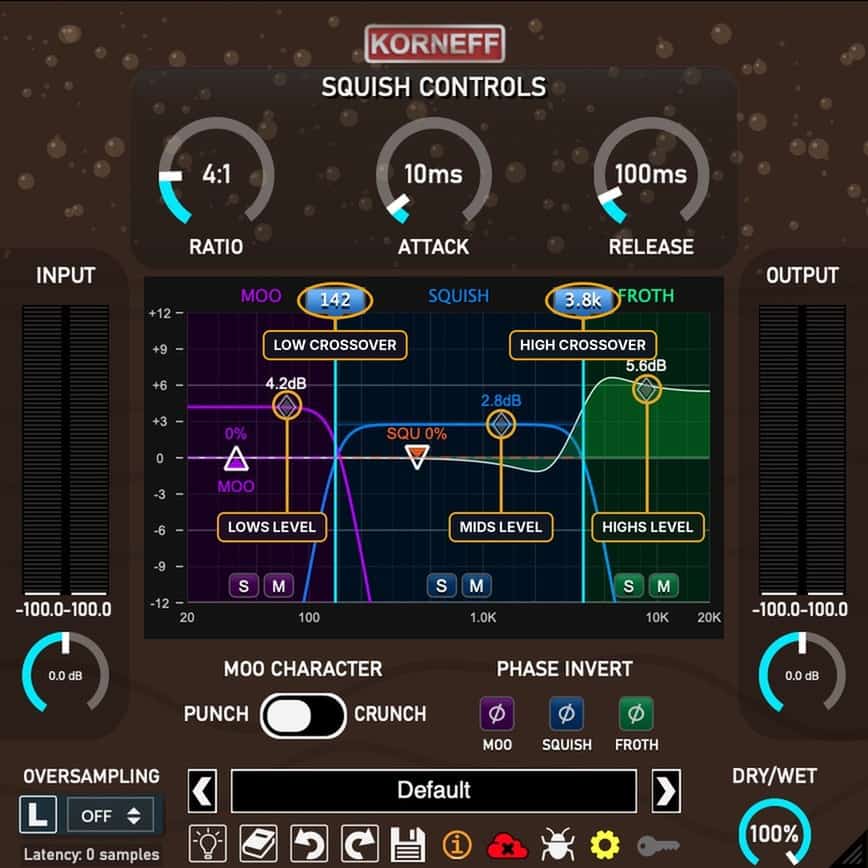
Move the first, lower crossover around a bit. You’re trying to focus on where the lows end and the midrange begins. There’s a little purple S—click that and you’ll solo out just the lows to help you hear them. The blue S will solo out the mids, the green S the highs. And the little M’s are band mutes.
Move the upper crossover to separate out the mids from the highs. In my particular case, occasionally there’s a loud clank sound coming from the bass, so I want that in the upper area and then I can drop the GREEN DIAMOND to lower the gain of a shelf EQ and remove the clank.
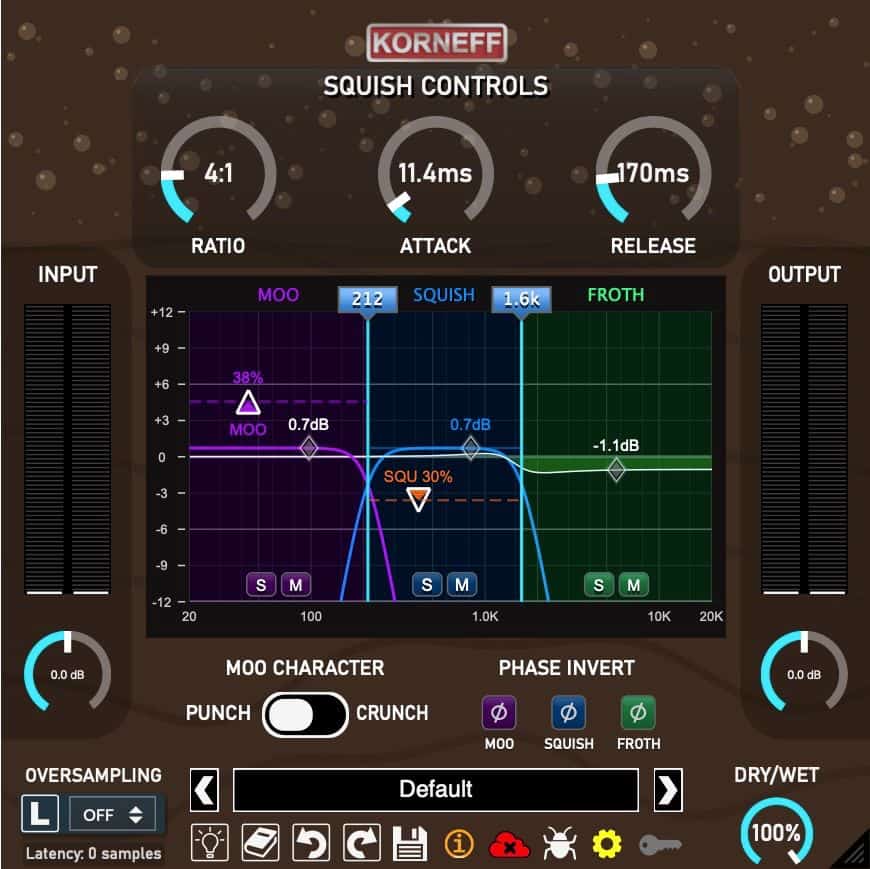
Here is a cool thing: the PURPLE DIAMOND and the BLUE DIAMOND are band level controls. So, once you figure out the midrange situation, you can now adjust the entire midrange up or down, or the entire low end up and down. It’s like a three-band EQ, or to my thinking, it’s three-channel faders that each control a different bandwidth. Below are my settings.
A Deal for You
We decided to discount the Chocolate Milk 40% off until Sunday at midnight, so if you try this fix out and it works for you, you can get both these plugins and save a bit. The DLC-2 is at its introductory price of $24.99 through our Black Friday sale, which is LOOMING IN YOUR FUTURE.
Seriously, these two plugins made just about the worst recorded bass I’ve ever heard mixable. The two work even better when the recording is decent. They work great together.
Y’all rock. Thanks for reading and being a part of Korneff Audio. We appreciate you!
Warm regards,
Luke