
Today we’re talking about recording kick drums with minimal money and equipment and not having it sound awful. Where to begin…
Bear in mind that most of the kick drums you hear on records these days are multi-mic’d—one stuffed inside, another outside, and a subkick mic made out of a reversed speaker, and then they add a bunch of plug-ins and a sample, all for something that goes Klonk Klonk … Klonk Klonk … or even just Klonk Klonk Klonk Klonk.
Kick Drum Recording
There are a million different ways to mic up a kick drum. I’m going to give you a bunch of ideas based on what worked in trying circumstances.
First, tune the damn thing:
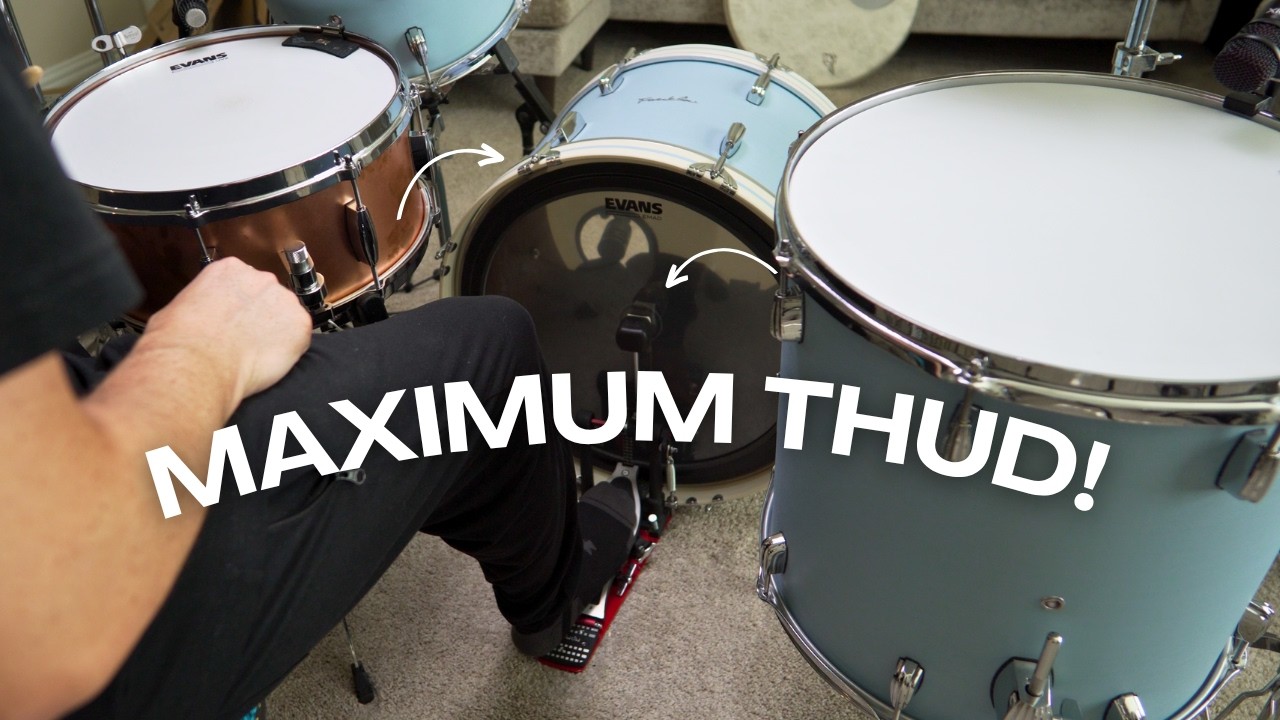
Here’s a DIY ‘subkick mic from a speaker’ video. Make this! Decide it sucks! Throw it in the closet!

You want to reduce unwanted resonance with kicks—with all drums, really. If you can take the tom toms off the kit, do so. They tend to resonate with the kick, especially the floor tom. In general when tracking drums, if the drummer isn’t hitting a certain drum or a cymbal on a particular song, take it off the kit and get it away from the mics. Cymbals add all sorts of reflections, drum heads and shells add resonance and reflections. You get better sounds faster with less drums.
I cover and wrap the kick in a blanket, like a packing blanket if possible. It cuts down on reflections around the kit, damps the toms and the kick itself, and gives a little bit more overall isolation to the kit. Leakage on a drum set is a war of inches. I do whatever I can to cut down on leakage, even if it seems dumb.
Have someone, perhaps the drummer, stomp on the kick pedal while you’re down in front of the kick. If the outer head is off, open your hand wide and move it into the kick and out. Often there’s a spot where you can really feel the kick punch into your hand. Consider putting the microphone there, where your hand is.
If there’s a hole in the kick, put your hand in the hole and move it around. Is there a power spot where you can really feel the kick? Consider putting a mic there.
I prefer a pretty big hole in the kick or no outer head. I like a blanket in there, weighted down by something heavy. To me, a kick should sound like a punch in the chest, right on your sternum. Punch yourself there a few times and listen. Good kick sound, isn’t it?
The beater is essential. I solved all my beater problems when I bought a Tama Iron Cobra and made the drummers use that. Very easy to get a lot of different attack sounds out of an Iron Cobra.
There are lots of kick mic choices. The best is a Neumann FET47. If you have a large diaphragm condenser that you can stick in the kick, you should do that. Feel free to experiment. If you’re using multiple mics, make sure at least ONE of them sounds full with a strong, articulate signal. Three shitty sounding mics don’t add up to a great sounding kick.
If you use multiple mics, correct the phase as much as you can by moving the mics, but then get them in phase in the DAW by shifting the tracks.
Check the phase relationships of the kick mics, the snare mics and the overheads. Bring up the kicks, then the snares, then the overheads. There will be some phase issues always, but what you’re listening for is a loss of lows or a sudden scoop out of the middle. Change polarity. Move mics. Don’t record things that sound out of phase and bad unless that is what you want.
People build tunnels by taking off the heads of another kick shell, or using gobos to make like a canyon sort of thing and then stick mics in that. Whatever stirs your cocoa. My best kick sounds were usually a single FET47. You don’t need the most interesting kick sound in the world. You need it to sound like a punch in the chest.
I compress everything going in. Here’s a thing: low frequency waves take longer to propagate and develop because the waveform is physically bigger. 50Hz takes 20ms to fully develop. A 10ms compressor attack time starts clamping down in the middle of a low waveform, causing distortion. Now, you might want that distortion, and it might sound good, but be aware of the possibilities here. Experiment with the attack time. Remember that with low frequencies, a compressor can sort of turn into a bizarre EQ.
Of course, you should experiment in general and have fun. Discover something interesting for yourself.
Kick Drum Mixing
Most of the time, a good kick sound on a record has a bunch of energy down low, like in the 30—50 Hz region, much less from 200 to 1kHz, and then more energy from 2kHz to 5kHz. Two mountains with a valley between them.
I used our SITRAL W295 Klangfilter EQ and no compression to get huge sound. Grab a demo of it to complete this part of the lesson. My front panel settings:
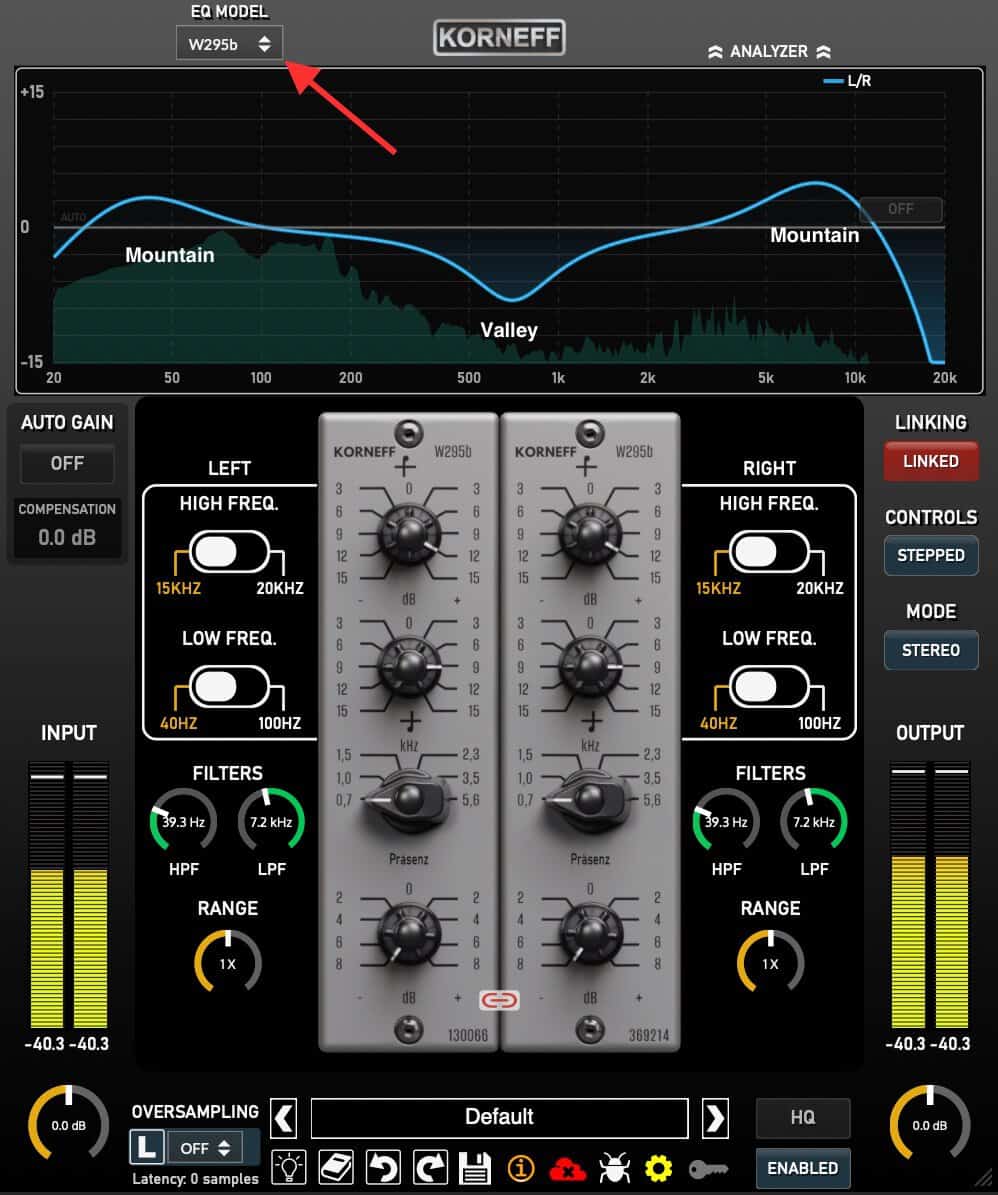
Switch it to the W295b variant so that you can do a maximal midrange cut—it only goes down to 700Hz but it works.
I added a large shelf boost at 40Hz and another at 15kHz. Now, the kick has no energy at 15kHz, but with a lot of boost, the SITRAL’s shelf goes down into the high frequencies of the kick. Remember, a huge amount of shelf affects a very wide range of frequencies. And don’t forget to use those roll-off filters to get rid of the highs and extreme lows and pull the whole thing together a bit.
Instead of a compressor, let’s use transformer overload to add some harmonics and thump. Here are the settings:
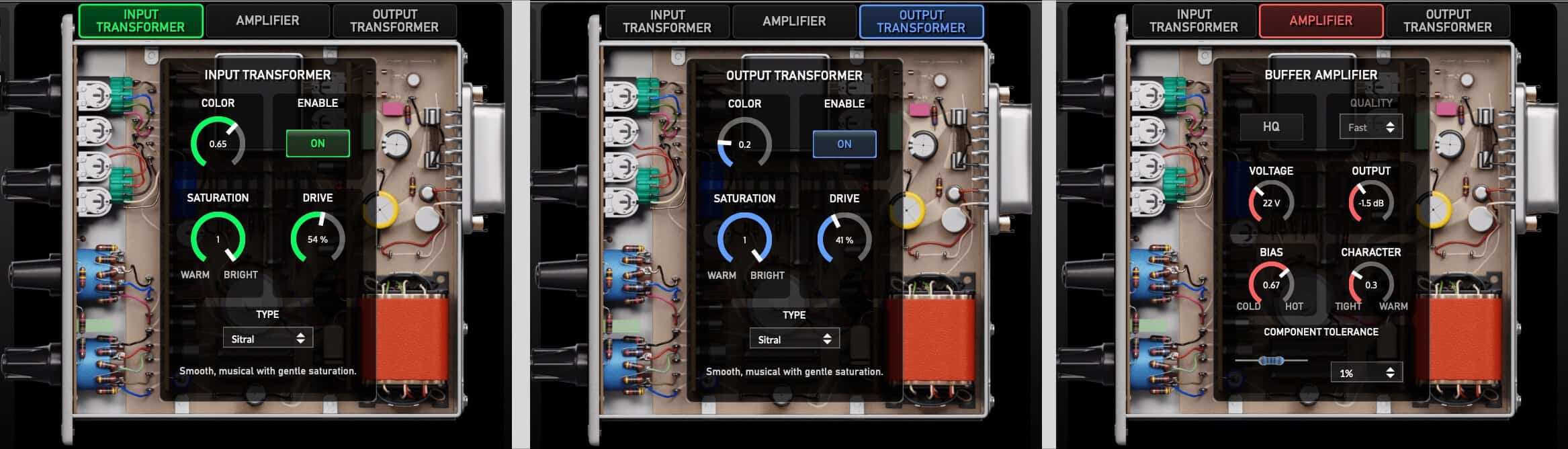
If you copy these, you’ll notice the INPUT TRANSFORMER has a very different sound than the OUTPUT TRANSFORMER. I am still on the fence with the BUFFER AMPLIFIER settings. Maybe too much crunch.
A cool trick: use the RANGE control to make the EQ settings even crazier. Crank it up to add a ton more boost and cut. The RANGE control, by the way, is a handy adjuster thing.
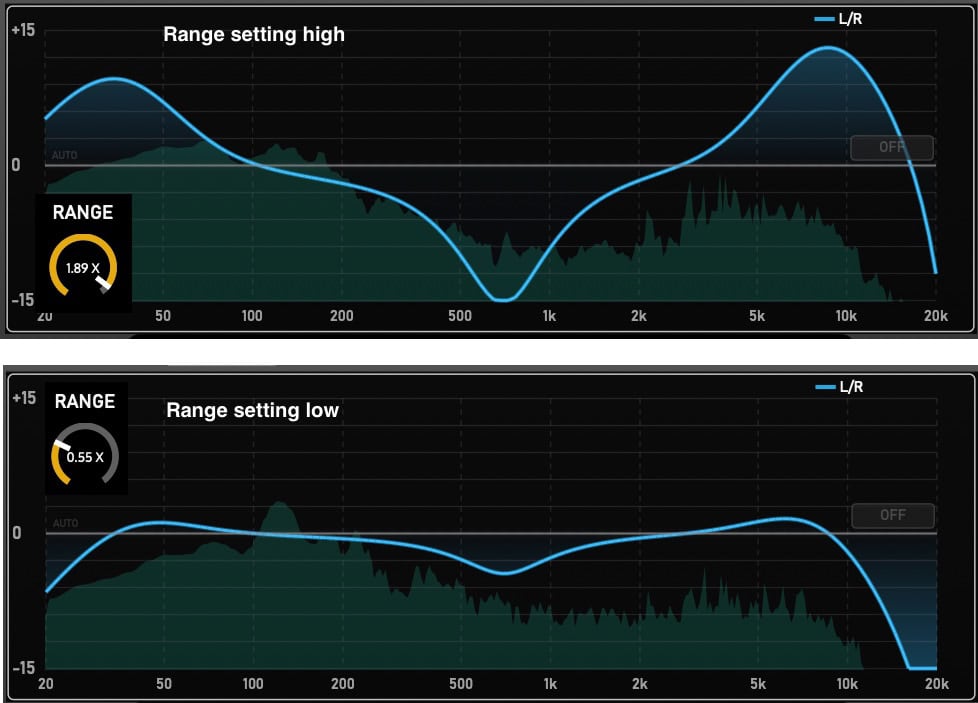
Get your basic settings with the main knobs, then tuck the kick into the mix and raise it up and down using the RANGE as a volume control of sorts. I like to make the kick sound overly processed and stupid, and then back it down a bunch using the RANGE. It works like a charm.
Next week: Overheads.