
I’ve been playing with our new Pumpkin Spice Latte 2.0, and it’s my new favorite kick and snare processor. The original was fabulous on snares. 2.0 is even better. Better on snares, kicks, and literally everything.
People have been asking me for videos. Careful what you wish for. I wrote up this tip and made a video. Welcome to the inaugural episode of Luke Dicks Around in the Studio: Fixing Lame Drums with the Pumpkin Spice Latte 2.0.
The Video is here:
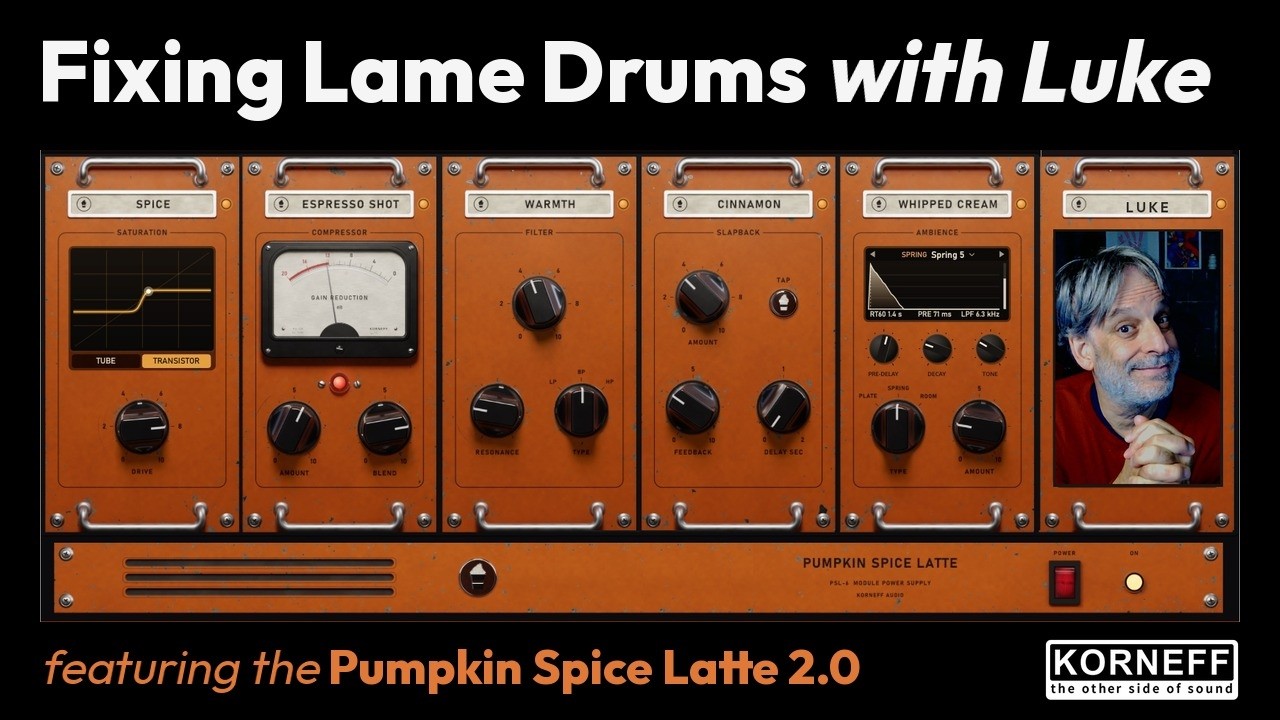
It’s long because I really explained things in a lot of detail, with A/B comparisons and some physics/tech stuff when necessary. But I also added chapters so you can skip around easily. I’ll make some shorter ones… but this one came out long.
I cover everything in the video, and also in this tip, so you can read it or scan through. The ideas are all the same, the video shows me using the controls and stuff. If that’s helpful to you, that’s awesome.
PSL-2 and Drums
On records, often the drums are distilled down, meaning they’re EQ’d and compressed to their essentials—the frequencies that matter most. I sort of hate this sound, because it is unnatural: snares and kicks are huge, sloppy things with wide, weird frequency response and resonances. But all that can be crazy hard to fit into a mix, so yeah, we have to shave things down, carving things into puzzle pieces that we’ll assemble into the final mix.
Usually, this is an EQ’s job, to cut frequencies away. The PSL-2’s WARMTH filter is AMAZING for this, though.
Why?
Because it isn’t a simple pass filter, which cuts things with no boost. If you crank up RESONANCE, the response curve develops a peak at the cutoff frequency. The more RESONANCE, the more ridiculously gained up that peak is. You can then move this around using INTENSITY and park it on the frequencies you wish to accentuate. It works incredibly well.
The extreme resonance on the filter comes from old analog synthesizers—a resonant, sweepable filter is a really common control on them. Added to the Pumpkin Spice, it’s an absolute secret weapon for drums, or really anything. Once you get a feel for how this works, it will be your go-to kick and snare processor.
Pumpkins on the Kick
The quick way to get a feel for how WARMTH works is to throw the PSL-2 on a kick, solo it in the mix, and turn off everything but WARMTH on the PSL-2. Open up the ANALYZER, switch TYPE to HP, turn up RESONANCE to about 1:00—you’ll see a spike in the frequency response curve. Run your DAW, and sweep the spike around using INTENSITY. I set mine down in the 50s, but you can put it anywhere. It’s amazing how much bottom end you can get out of this. It’s also very sharp—a very narrow bandwidth. You don’t bring up anything muddy, just the exact frequency you want.
I also needed to get some more highs out of it, so I switched in SPICE, the saturator on the PSL-2, set it to TRANSISTOR, and cranked up DRIVE.
Remember, saturation adds overtones going up in frequency, so it basically functions like a boost-only shelving EQ, only with minimal phase shift. Also, because you’re increasing density—you’re adding in frequencies that weren’t there before—it gets a little bit louder. WARMTH and SPICE together are your equalizer. The TRANSISTOR setting has much more effect than TUBE. I use TUBE when I want something warmer and perhaps more musical. TRANSISTOR is more clanky and harsh—perfect for adding a percussive element. So, WARMTH to boost the lows, SPICE to add in some highs.
I also switched in ESPRESSO SHOT, which is a really punchy compressor. It brings out the click of things. I didn’t want too much click on the kick in my video example, because I was looking to get it to sound more 808-ish, but I did want to get it sounding more articulate, and bringing out the transient does exactly that.
In general with ESPRESSO SHOT, I start with BLEND fully clockwise and turn up AMOUNT, which is the compression, until I get a feel for how much is too much, and then adjust it down. You can back the compressor down two ways: lower AMOUNT, which will lower the compression, or you can lower BLEND, which will add back uncompressed audio. Remember, ESPRESSO SHOT is a parallel processor, which is a nice thing to have at your fingertips. I have no rules as to when you should back off compression vs. DRY up the blend. Use your ear.
I added reverb (WHIPPED CREAM) to the kick to give it some sustain and resonance, like an 808 might have. On the PSL-2, you can pick out the type of reverb and its basic size and tonality, and then further modify that with DECAY and TONE, as well as PRE-DELAY. To extend the kick, I picked a plate and rolled off the top and cut the decay time down to 400ms—just enough to add a sort of low rumble to the kick.
PLEASE—when you’re working with the PSL-2, SWAP AROUND THE MODULE ORDER! I can’t emphasize this enough. I’m almost always rewarded by something better when I mess with the modules.
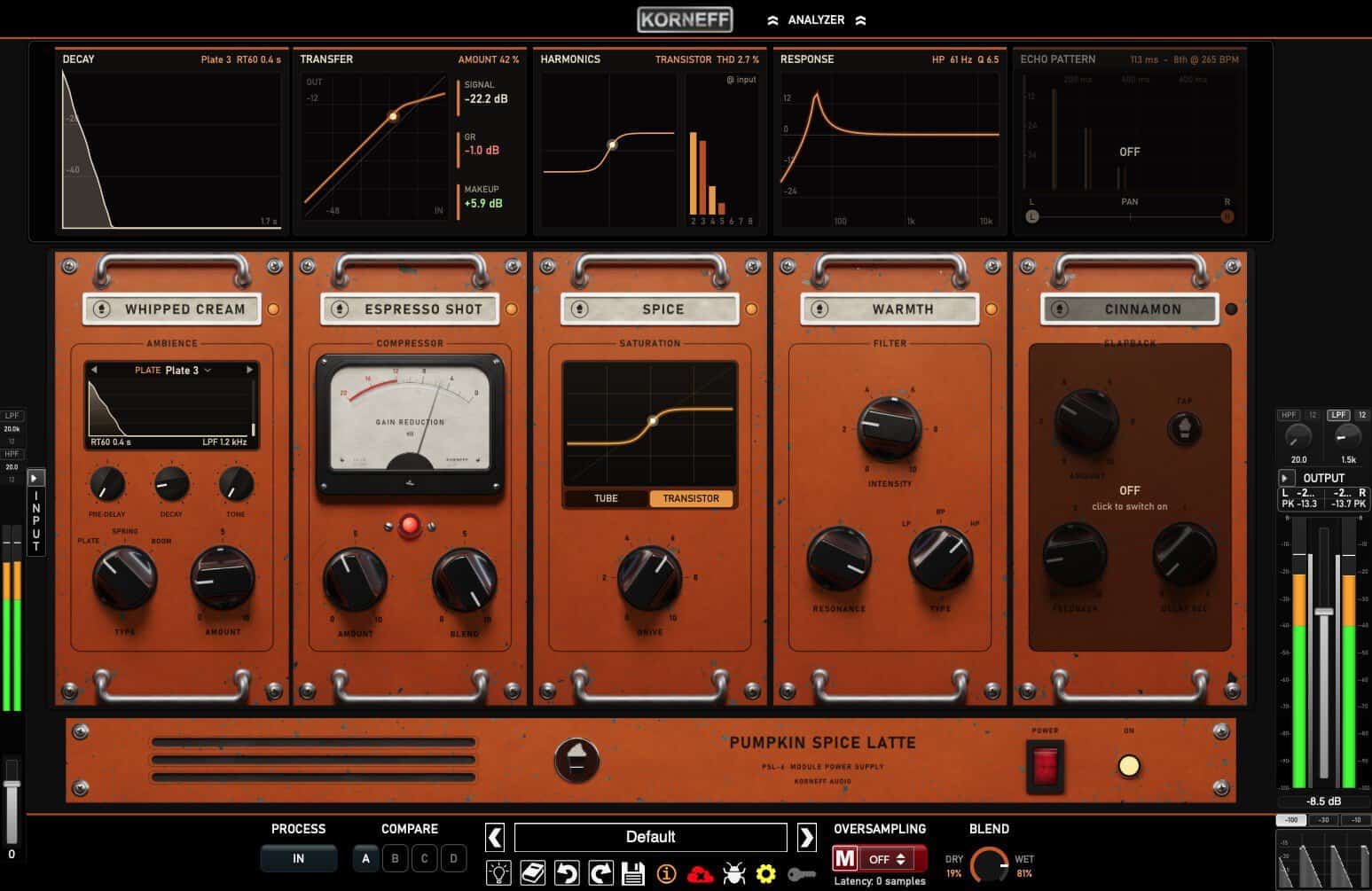
Here’s a link to the Kick Section: https://youtu.be/qD7KWC_3fxI?si=RDXf4vWU1LCiIw_A&t=74
Pumpkins on the Snare
I used a similar process to work on the snare, but instead of using the HP filter, I used the LP, with RESONANCE up to add a resonant bump, to focus the snare down to its essentials. By the way, pop the ANALYZER in when you’re using WARMTH. It always makes life easier.
The snare didn’t need compression—it got too clicky, but it really benefitted from a short delay. Turn on CINNAMON, set FEEDBACK low—I think you want one slap—and then set delay somewhere between 20 and 40ms.
At delay times below around 30ms, your ear hears direct and the slap as one composite sound. Above 30ms, your ear hears the direct and the slap as separate from each other. In the 20 to 40ms range, the direct and slap are sort of blended and not, and the overall result is the snare sounds bigger, and perhaps there are some cancellations that change the frequency response in a good way. Whatever the case may be, adjust DELAY SEC until the snare sounds bigger to you.
WHIPPED CREAM… I use this to add some room to the snare, or perhaps a little reverb to have it last a bit longer in time, which makes it appear bigger. In this example I used some spring reverb, but in a rock context, I like Room #1.
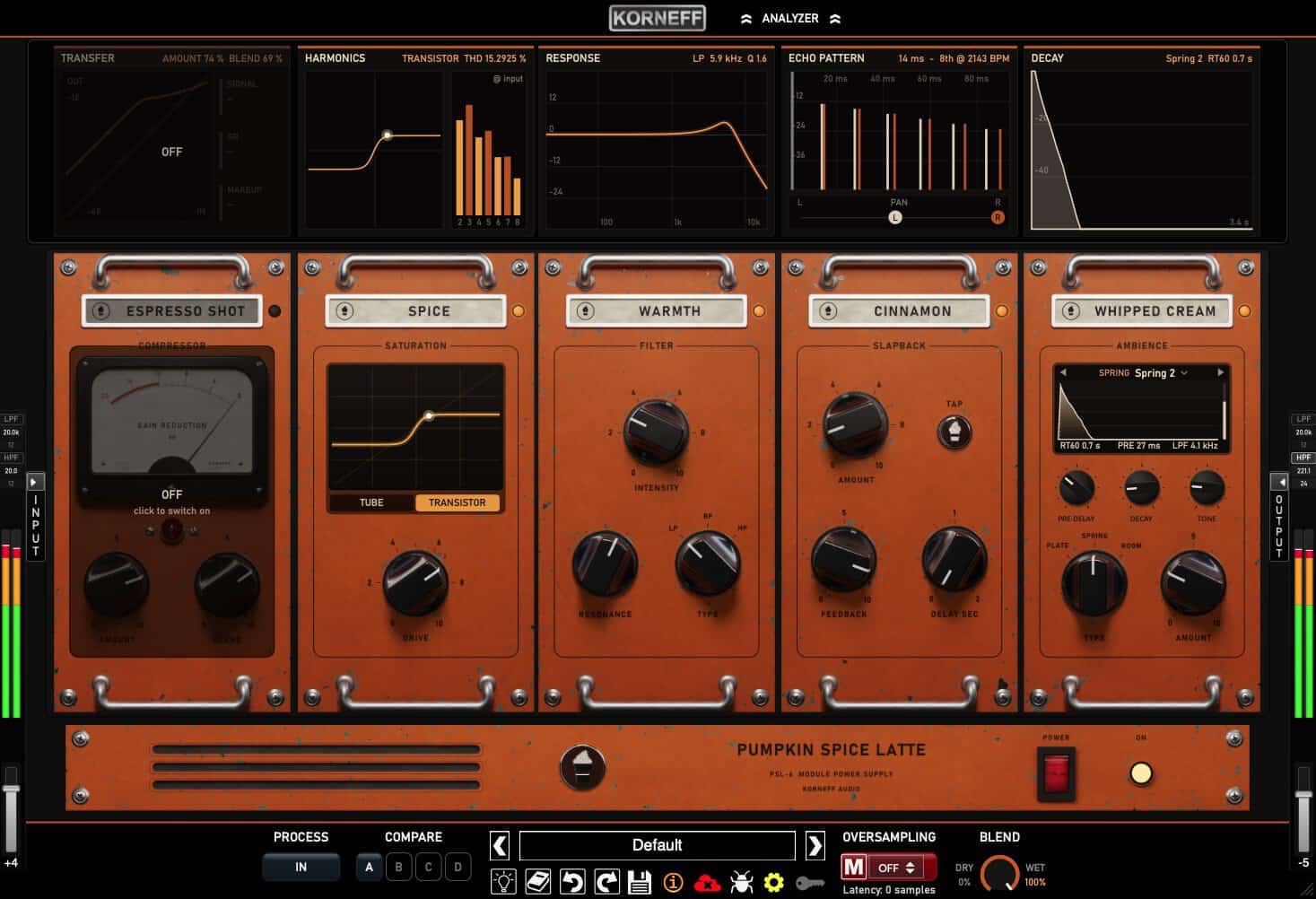
Here’s a link to the Snare Section: https://youtu.be/qD7KWC_3fxI?si=Uzreitd5GqdRSv8L&t=557
Pumpkins on the Bus
I threw the Pumpkin Spice Latte 2.0 on the drum bus for a little more squashy squash. This was a simple setup—a bit of tube SPICE chased by ESPRESSO SHOT, the saturation there to give a vintage vibe to the compression. When you do things like SPICE -> ESPRESSO SHOT, by all means try the two in reverse, ESPRESSO SHOT -> SPICE, and see which you like better.
Again—the best feature of the 2.0 is being able to experiment with the signal chain order.
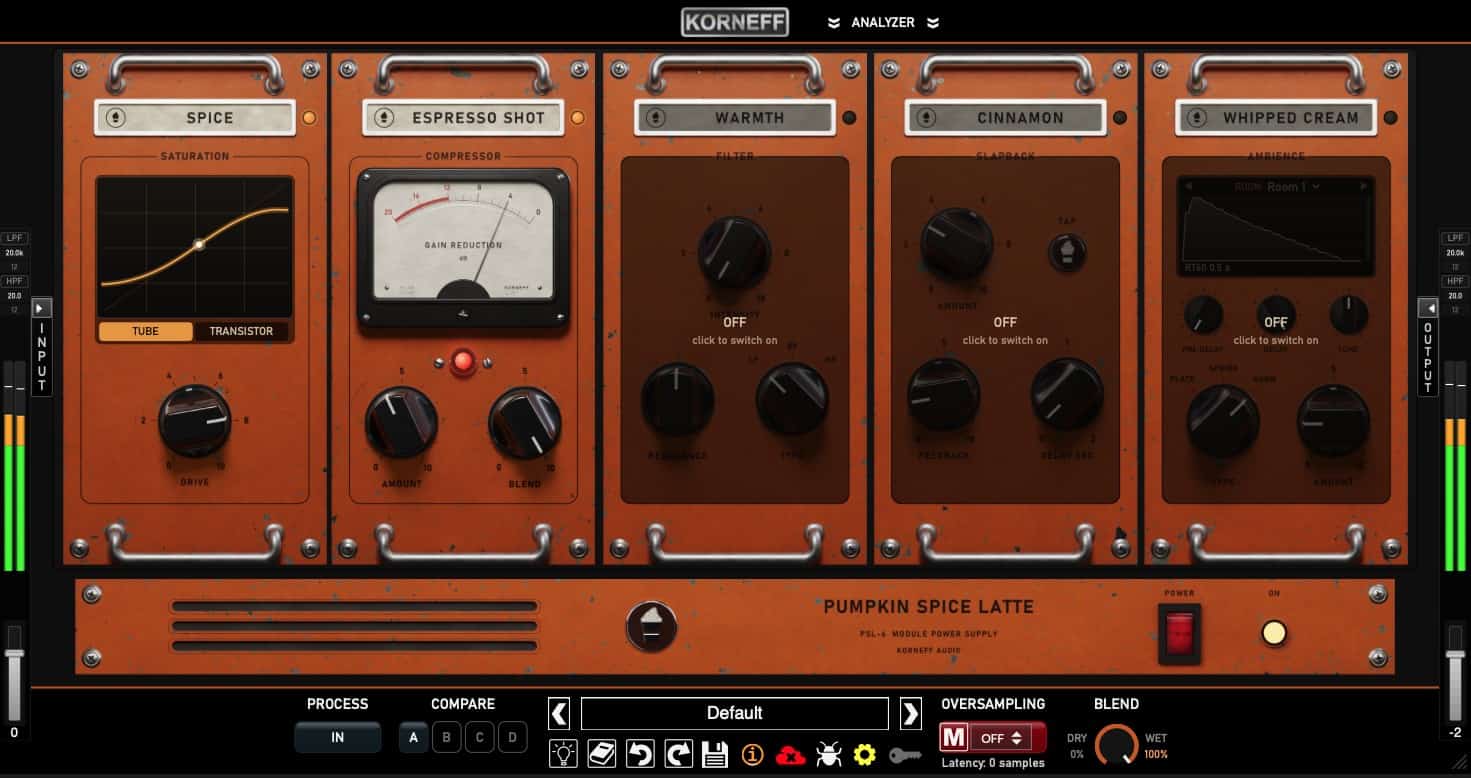
Here’s a link to the Drum Bus Section: https://youtu.be/qD7KWC_3fxI?si=JCCCqnqKYwbxZCBC&t=941
More Pumpkins Everywhere
I ran everything through the PSL-2 on this little mix, and I documented all of it for you. The video has chapters so you can not sit through the whole thing. Some of what’s there for you to learn from:
Congas and Hi-hats: Delay makes it sound like a guitar part off a Curtis Mayfield record.
Guitar: Weird filtering and delays and reverb.
Bass: I wrecked it… don’t know what was wrong with me… but then used DRY/WET Blend and fixed it.
Vocals: This is a loop of a ghostly/angelic thing—fun with delays, reverbs, compression… basically I Pumpkin Spice’d the crap out of it… but subtly.
So, there it is, a bunch of Pumpkin Spice Latte 2.0 tricks to try.
Some of you prefer to read, others to watch videos. Let me know what works best for you. I hope to get better at making these things for you all.
Warm regards,
Luke