

Korneff Tips 05: Fixing Badly Recorded Electric Bass
Yo! Dig the awful stock photograph of a bassist! I thought bass was hard to record. Evidently it's hard to photograph!
Cruddy stock photography aside, electric bass is a really difficult instrument to record well, unless you have a great player with a great instrument, and a good DI, and a good amp and some mics. Even then, it's not easy to record. And then mixing it, you have to get it to sound good on both big speakers and really small speakers, and that’s a pain in the head too.
A reader asked for some hints. There are a ton.
Hmm... what can be done using only the KA1776 from Korneff Audio?
I found a really badly recorded bass track, a live in the studio thing with a good player and good equipment and it still came out sounding like ass. No articulation, no bottom end. Dreadful.
The First Thing Is to Listen and Come Up with a Plan
Two tracks—a Bass DI and a Bass Amp track. After getting phase situation straightened out, there was some midrange on the DI track, and a cloudy ground mist of bass on the amp track.
Step One: First, we squash the crap out of the DI track to even it out as much as possible and get as much finger articulation as possible. That sounds like... KA1776 set really fast, and to SERIAL UNLINKED—our friend, double compression.
Squash the Mids and Up
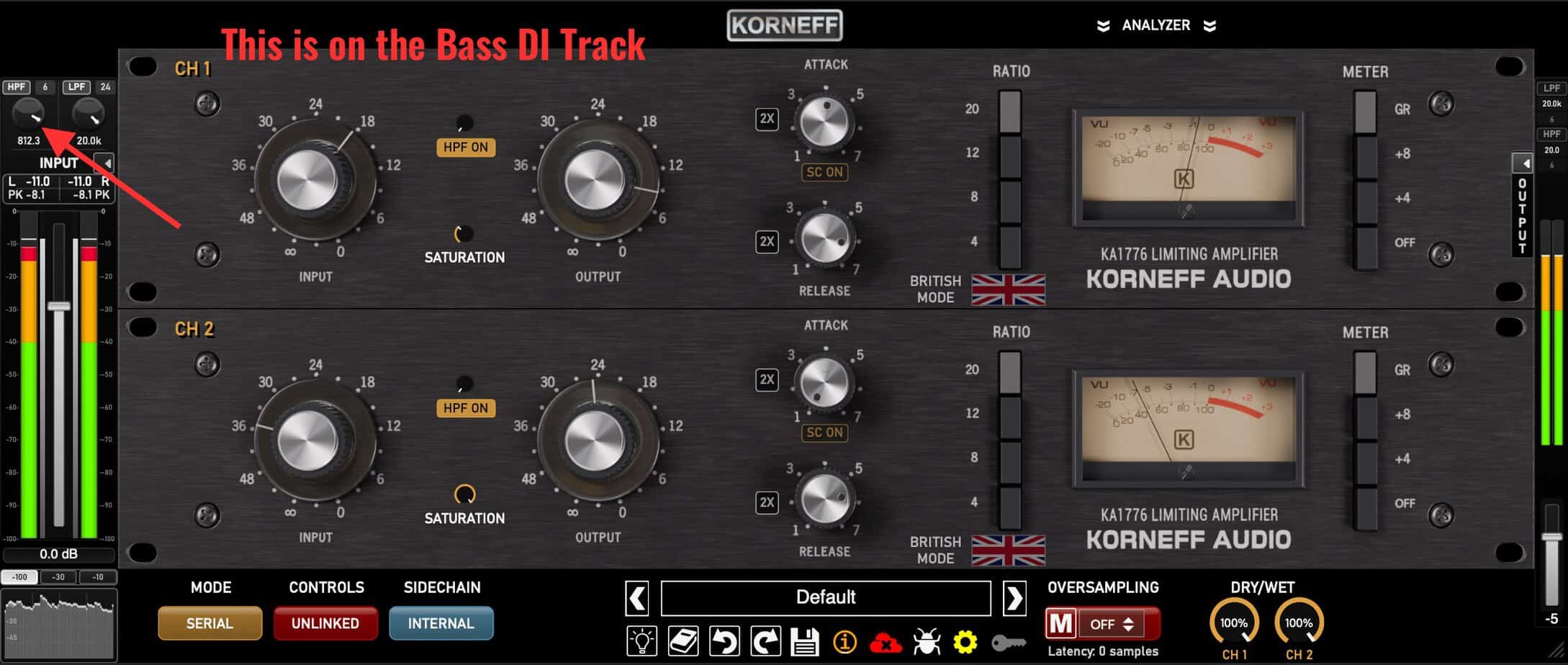
KA1776 settings for mximum articulation out of a bass DI track.
Look at the Input Filters—I rolled off things around 850hz. Really, all this channel has is midrange.
The rest of the settings... these are weird settings, to be honest. I just played with knobs until it sounded less like ass. I have a theory on why this works.
Higher ratio means a hard knee, and means the compression is VERY jumpy and really responding to the signal's ups and downs. It evens it out a lot. ATTACK is on the slow side, RELEASE is fast, and that makes sense: we want the compressor to even the signal out a lot (short release) but we want the transients and finger noises coming through. I also think the high OUTPUT setting of the first unit is doing something—it sounded better with the OUTPUT cranked up and the next INPUT turned down, so that's how I keep it.
The second KA1776 has strange settings too. Basically more really fast compression. I did this all by ear, screwing around for 20 minutes 'til it sounded somewhat better.
Squash and Saturate the Lows
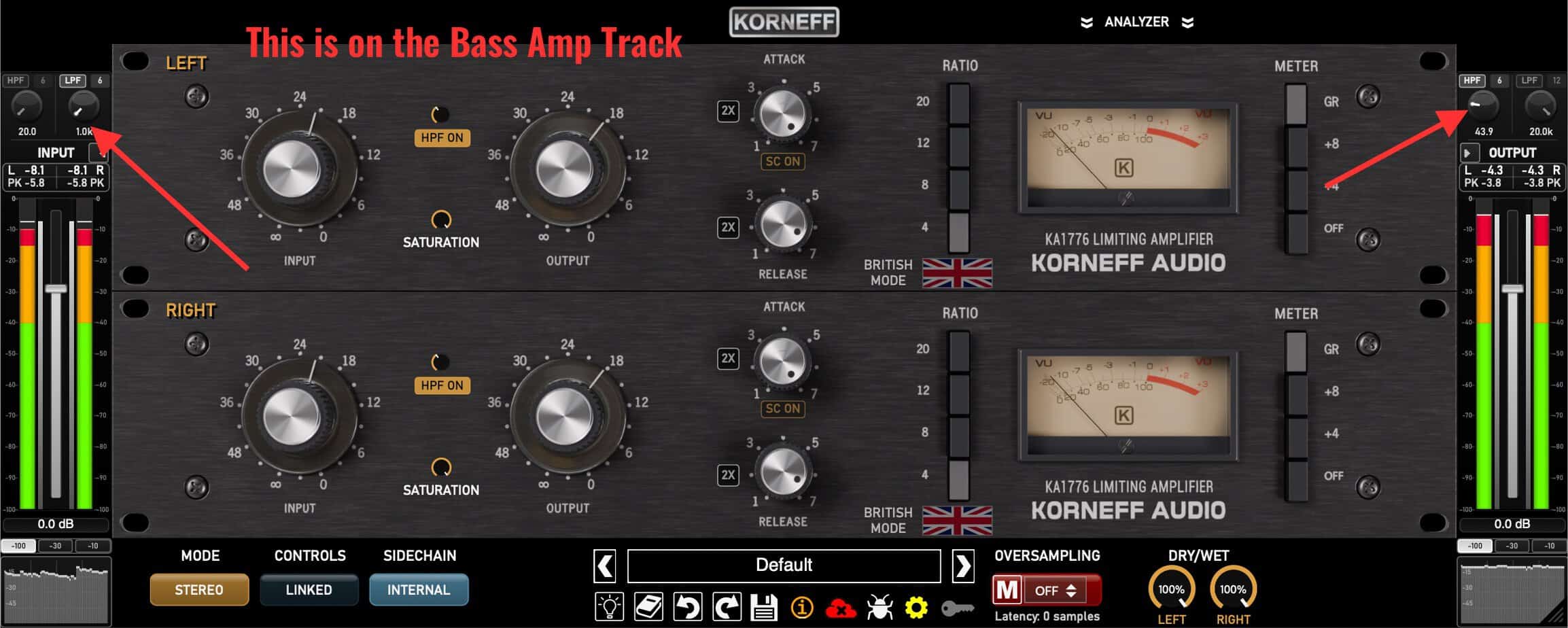
KA1776 settings for maximum low end out of a bass amp track.
Step 2: Fake the bottom end by basically making the compressor behave badly—get it pumping and distorting by setting everything too fast.
Look at the filters: Input filters are rolling off everything above 1000Hz, and then there's an Output FILTER to remove a little of the lows.
Why not roll off the lows BEFORE processing rather than after?
Because I want to add harmonics using harmonic distortion, and I'll get more of that the more low end I have. So first generate TOO much low end, then get rid of a little of it.
Saturation is cranked up, ATTACK super fast and RELEASE really fast. I want the KA1776 pumping and riding individual peaks and valleys of the waveform as much as possible. Anything to squeeze some bass out, and then compress it.
It Still Sounds Like Butt
But butt is a step up from ass. So it is better. I can get a mix from this now.
Then... I tried one last little thing: I made a copy of the Bass DI signal and added it in with no processing at all. That really helped. It turned all the bass processing into... PARALLEL PROCESSING! The final bass was a heavily compressed Bass DI track with the KA1776 in SERIAL killer mode, an unprocessed DI track, and the squashed, pumpy and saturated Bass Amp track.
Whatever. It worked. Of course, there are other tools to play with, such as EQ, and the TrueBass on the WOW will certainly wind up on this eventually, but at least there's something there that somewhat sounds like a bass. Our Chocolate Milk would also work well on this application, but I'm on a use the KA1776 for everything spree. Until next week.
If you've got particular questions or things you want to see, send them in.