
Happy Monday –
While driving through the mountains from Montreal to New York City, I heard one of the worst songs imaginable. It would have been utter hell if it wasn’t so funny. It was a chunk of colon lining from Skynet itself. Terminator if it was raised by some guy, aspiring to write music in Nashville but only managing to get to a Days Inn outside of Wilmington, Delaware. And there, dreaming of his girlfriend from high school, Heidi-Jean, he typed out a prompt that must have read like this:
“Suno, you’re a modern country producer and songwriter. Craft a tune that combines all the pain and clichés locked in my heart since Heidi-Jean left me to work at that accounting firm in Pennsylvania. It should have spoken-word parts, in a deep, resonant, manly voice, drenched with reverb. There should be very tasteful blues guitar work that sounds like a Strat in the out-of-phase position between the middle and bridge pickup; the style a mix of Santana and Clapton, but missing anything that might make it interesting. There is a woman’s voice too. Sometimes she should clearly sound AI, or like there was a brief power failure. In the bridge—let’s have two bridges, what the hell—the male voice should go high, sounding like a Viking getting castrated. Like, he’s got a 19-octave range or something. Think Erling Haaland meets 80s Jean-Claude Van Damme but somehow it’s Steven Seagal. If a mullet and a perfectly trimmed beard played a PRS and had an upper arm tattoo that in Chinese characters said, “If One Must Suffer, Suffer for Love,” but it actually says, “Do Not Flush Tampon Here, Yankee Woman,” that would be this song.”
Listen if you dare.

I can’t help but laugh hearing this lump of robo-turd. I imagine the poor slob who’s prompting this crap—he or she has made like five albums of this dreck this year… for 26 views on YouTube. AI conquers the world one urinal at a time.
If anyone wants to feed that prompt into Suno, please do and send the results to me.
Now we must clear our palates.
Mandocello
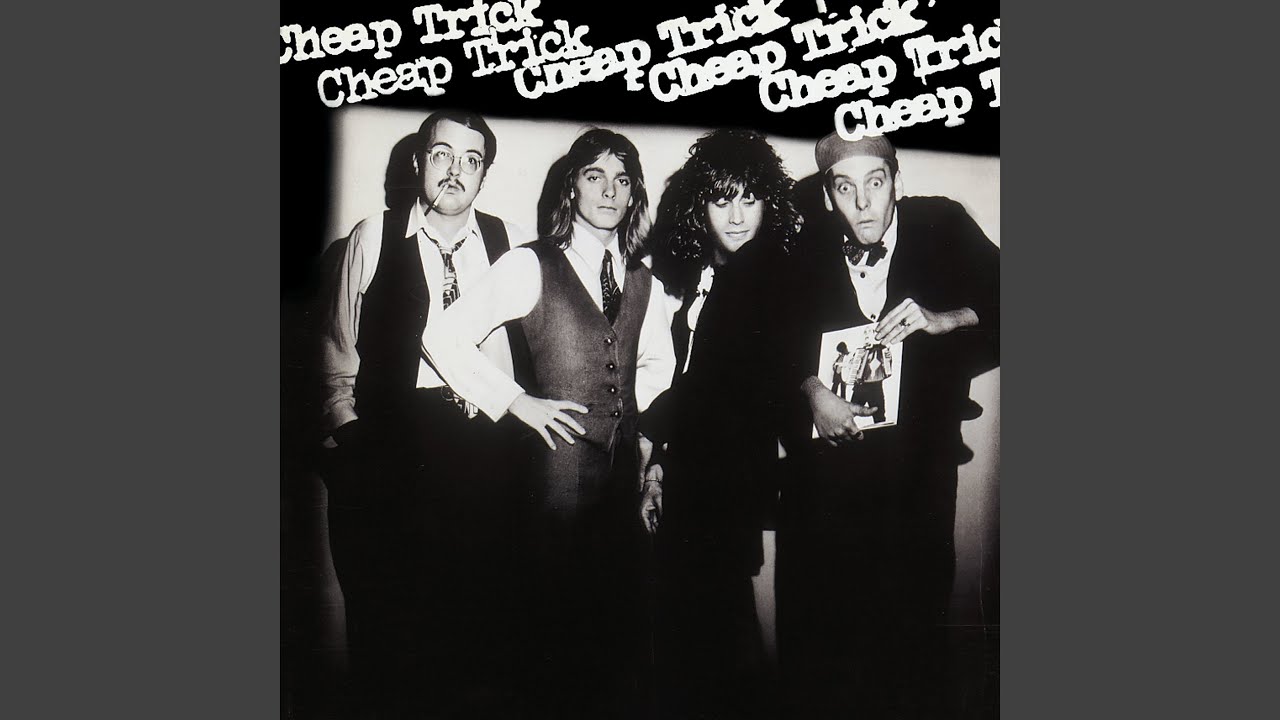
Cheap Trick’s 1977 debut album is killer. Produced by Jack Douglas and engineered by Jay Messina, it’s one of the great debut albums and the more I listen to it, the more I think Rick Neilsen is a genius—he wrote or co-wrote all the songs.
Nothing, though, beats the fourth track on side one, Mandocello.
Some things to listen for:
A mandocello (which is like a mandolin but pitched lower) at the top with delay pulling it from right to left. Anyone else hear an organ pedal tone off to the right?
The Bass—it’s an 8-string, and what a sound! Doubled by a guitar to the left, I think.
Drums—sounds mono. Sounds like it’s compressed through an 1176. This might be “New York Compression” like I mentioned in last week’s tip. More on that later in the week.
The vocal—it’s faded in. I don’t think it’s a reverse reverb or anything fancy, just a great singer, Robin Zander, holding a note.
On that descending riff, it’s vaguely doubled with a piano on the right.
There’s a shaker occasionally on the right; it’s very quiet.
The arrangement doesn’t have a chorus, but it does have various sections. Note that each section starts the same, but then it’s different. You’re set up to have an expectation of one thing, and then you get something else. This happens all over the song. There are slight changes in length, or parts start one way and then switch direction. It’s very clever and throws you off balance. I refer to this tactic as a “Rabbit Trick” in previous episodes of New Monday.
First bridge — another guitar on the right, and gorgeous harmonies panned out.
Second bridge — the guitar parts are rather Jimmy Page-esque — a string section, really. And an interesting shift to the vocal. I don’t know how to describe it. It suddenly has a swagger. Like the singer suddenly grows a pair.
The lyrics are perhaps a meditation on a long-distance relationship:
I can hear you laughing
You’re a million miles away or you’re here
I will never leave you
But I’m a million miles away or I’m near
There’s an indecisiveness. And also an indistinctness, a blurriness. What does a million miles away or you’re here actually look like?
But in that second bridge, images get more concrete:
We can go down slowly like the rain
I could leave and be with you again, oh
I could be your lover, let’s pretend, oh oh
We can rain. People can leave where they are. And he propositions her: I could be your lover. There’s something sexy about that second bridge.
And then there’s a guitar solo. It starts with a wandery bit of blues, and then sweeps into something glorious and wet, melodic and somehow triumphant, and ending with a series of staccato single notes. It is SO SIMPLE, and so perfect.
Listen to Mandocello.
Listen once, then listen again. Find all the things there are to find.
1176 All Over the Place
To my ear, I hear 1176 everywhere on this. Jack Douglas definitely used it on vocals, but the overall snap and character of the bass, the drums, the entire mix, sound so 1176. And when they were recording this in 1976 at The Record Plant in NYC, what else did they have? An LA-2a and maybe some Allison Research Gain Brains? Or an ADR Compex?
All of them—the 1176, the Gain Brain and the Compex are FET units, like the KA1776, and they have a particular sound.
I’d even guess that the entire mix is compressed with a pair of linked 1176s. Again, that is what they had in 1976.
Stereo Bus Compression with a KA1776
The 1176 isn’t a first choice for overall mix compression; the default for most people these days is something based around a VCA, like an SSL Bus compressor or a knock-off of it. The 1176 gets into the nooks and crannies of the mix, rather than riding over it and pulling it together like a VCA-based unit. You can hear this on Mandocello. The drums are sort of their own thing, almost like they’re not part of the mix, and the whole thing is a bit prickly.
I don’t know the settings for Mandocello, but here are some ideas for you, to inform your approach.
RATIO: Start at 4:1. This will be the smoothest the 1776 can be. It gets more spiky as the ratio goes up.
ATTACK: I’m thinking between straight up (4) and 5. This is actually very fast compared to where you’d set an SSL Bus compressor, but the two are so different. You’ll notice that you’ll need longer attack times to allow the kick’s transient to develop. Faster attack times will tend to clip the kick a bit prematurely.
RELEASE: I’m setting the release on the fast side. Remember on the release, WATCH THAT METER! It should move musically. I find with the KA1776, when I use it across the bus, it’s down around -5 the entire time, but it has a nice bounce to it.
Here’s a grab from a song I was working on with similar sounds and dynamics. Notice I have it set to unlinked Mid/Side… I just can’t get enough of that setting!
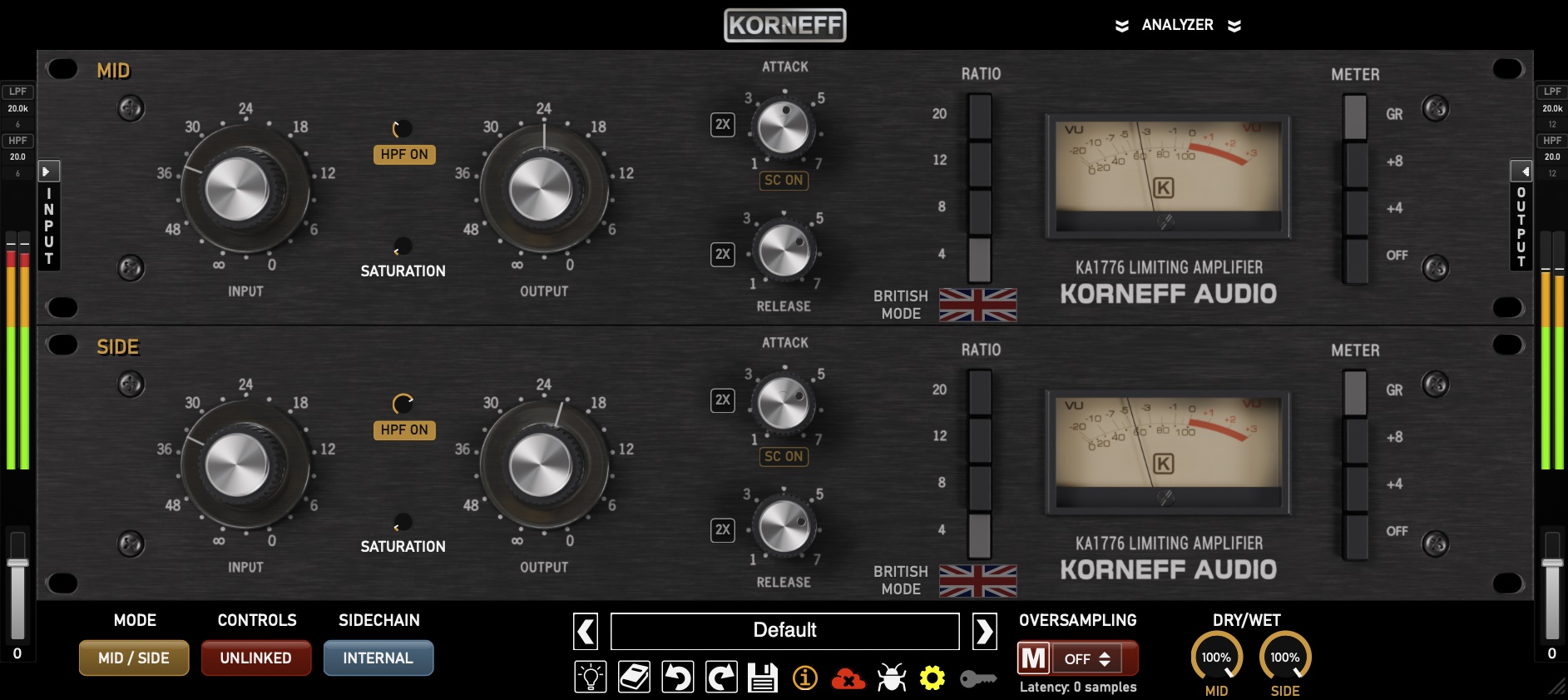
I’ll have to make a few videos on how to set up the KA1776 for some of these different tasks.
The KA1776 is still on sale for $17.76.
That’s all for this Monday. Have a great week, all.
Warm regards,
Luke