
New Monday #123
Happy Monday,
First of all, Happy Father's Day to all you fathers. I hope your kids bought you vintage condenser microphones. If they didn't, and all you got was a World's Best Dad mug, here's two things you can do.
1) Use the mug as a resonator. Stick a directional mic in it, point the opening towards a guitar amp and you'll get a strange, resonant sound with a midrange bump to it, similar to the sound you get when you stick a mic down a piece of pipe or the tube in the middle of a roll of paper towels. This also works for vocals and you can cup your hand over it rhythmically. Lastly, if you hold the mug in your hand and twist your wrist so the opening changes position in relation to the source, you'll get some flanging. Hang it from the studio ceiling and spin it in a circle while someone plays drums for a modulating room sound. I have another modulation trick, but one of you has to write and ask me what it is, and I'll give it to y'all next week.
2) If you didn't get a mug, and instead a tie, or if you're not eligible for Father's Day, we have you covered. Go to our website and get an Amplified Instrument Processor for only $99—that's $70 off. That's a lot of savings. Think of all the beer you can get with $70! You can also take our AIP Course, which explains a lot about how to use this thing. Seven lessons, one for each module of the AIP, plus lots of tips and tricks.
That Pre-amp Video
There's a video going around by a guy named Jim Lill that is causing a ruckus online. Search for it—it will turn up.
The basic premise is that all pre-amps sound the same—he's specifically comparing a Neve mic pre to a Focusrite Scarlett. He supports his viewpoint with measurements.
It's worth a watch. It is well thought out and assembled, and there's a lot of information in it that's good.
There are also a ton of rebuttal videos. If you have a few hours, it is worth going down the rabbit hole on this topic. You will learn a lot—a lot of terminology, electrical engineering and audio concepts, measurement techniques, etc.
Don't have a few hours? Read on:
Look, my dudes, all pre-amps don't sound the same, and you can listen to them and hear the differences. The differences range from inaudible to huge and very obvious. And you can all hear this.
So, why does Jim seem to have it wrong?
He's simplifying. He's simplifying everything by making assumptions that reduce the complexity involved, of the physics and recording technique.
Let's kick over his Lego set. As an example, he points out that the two pre-amps he's testing have the same frequency response, and he does this by sweeping the test frequency from 20hz to 20kHz and then plotting that output. It is flat, therefore they sound the same.
There's a lot wrong with that.
I've no doubt that as a voltage measurement, the voltage is the same at each frequency, and that would look like a flat response. But our ears don't hear voltage. They hear sound. Sound exists across time.
I wrote about this here: More Pass Filtering and Minimal Phase Filtering.
Circuits process signals at different speeds for different frequencies. Speed isn't a good word. What happens is that frequencies of the signal don't get through the circuit all together at the same time. Some get through a little ahead of others. This causes a smearing of transients and also a change in perceived frequency response, because we hear some frequencies later than others, which changes our perception of the signal, because our ears experience it across time.
An analogy: You're in the kitchen cooking. The room smells like steak. Someone cuts into a lemon and for a split second, the kitchen smells of lemon, but then it disperses and the room smells again of steak. Same kind of idea.
Is this subtle? Yep. Can you always hear it? Nope. It depends on the equipment and the signal that's feeding it.
Why?
Everything interacts. A lot.
A sweep presents each frequency to the circuit one moment at a time. But that isn't how things work, really. The frequencies don't line up one after the other like kids on a water slide. Sounds burst through the microphone and the cables and into the pre-amp all at once, and that adds a dumpster load of complex behavior.
To make this short, let's just look at one area, harmonic distortion. I wrote a bit on the topic here: Harmonics and Harmonic Distortion.
In a nutshell again, all circuits—tube, transistor, whatever—impart a tiny bit of harmonic distortion to a signal. They actually add in extra frequencies, called harmonics. Yes, these harmonics are very quiet, but they build up and interact with each other.
They build up because we're not just pushing a sine wave through. Instruments and voices also generate their own harmonics, which is a big reason they sound the way they sound. So, these complex things go through a circuit, which adds its harmonics to everything—all the fundamentals and all the harmonics. Circuits add harmonics to the harmonics, and if we feed that harmonically dense signal into yet another circuit, that adds its harmonics to the harmonics to the harmonics. It's ungodly complex.
Then, there's also intermodulation distortion. That's a whole other sidequest you can go down: Inharmonicity, Strike Tones and Intermodulation Distortion.
AND THEN... engineers overdrive the circuits, either on purpose because they know what they're doing, or accidentally because they don't. But that overdrive adds saturation, which adds even more harmonics to the harmonics of the harmonics, more intermodulation distortion, etc.
Jim, in his video, made the assumption that nobody does this deliberate overdrive thing, that everyone tries to record cleanly. Hahaha!
Hear it for yourself
You might only have your audio interface and aren't able to A/B it with different pre-amps. That's fine, you can do this:
Download an Amplified Instrument Processor demo. Stick it on a channel.
The AIP has a switch on the front panel or a module called the Proprietary Signal Processor. Click that on and then hit the nameplate to go around to the back.
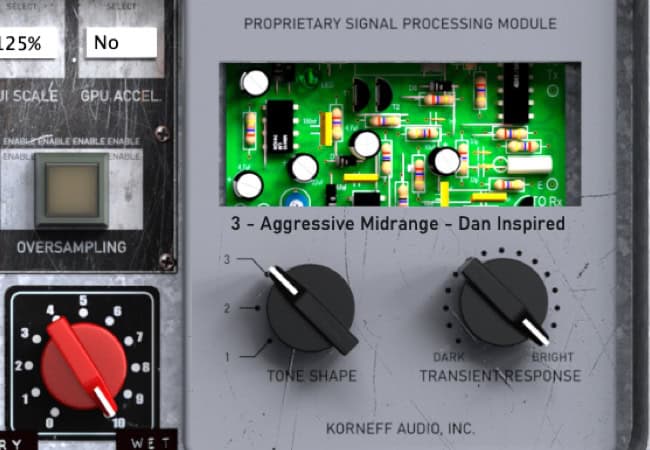
Run some different signals through the AIP—a guitar track, a drum set, a vocal, a whole mix. Switch between the three different PSP settings, Tape, Tube and Solid State. Each of these imparts slightly different patterns, if you will, of harmonic distortion to the signal. In some cases you won't hear a difference, or it might be slight, or it might be quite noticeable. Why? Because the whole thing is COMPLEX, which is what I've been pounding on this whole email.
Go to the INPUT GAIN of the AIP and turn it up, and turn down the OUTPUT GAIN to compensate so things don't get loud. Now the AIP is modeling saturation. Switch between the three choices. You'll notice they all sound different.

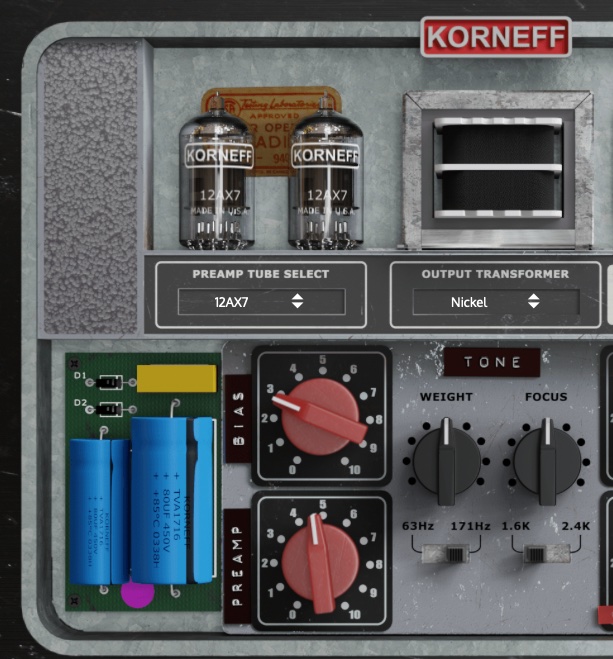
Go to our website and download the Pawn Shop Comp demo. Again, stick it on a channel, hit the nameplate and go around back.
Now, swap the tubes around. Hear a difference? Swap the transformers. Hear a difference? Turn up the PRE-AMP GAIN, adjust the BIAS. Do you hear the differences?
Clearly, we can hear the differences. It isn't always audible; it depends on the circuit, the audio source, the recording technique, but it is an audible thing we can hear.
Sound isn't as simple as voltages on a graph and numbers and math. It's a complex thing. Which is why we take forever to make our plug-ins! Hahaha!
Anyway, that is all for today. Quite a bit of tech. I hope I made it a bit easier for you to understand. Feel free to write with questions.
Happy Father's Day belated, dads.
Warm regards,
Luke