Last week I wrote about the phase issues that might become a problem when you’re using pass filters, specifically high-pass filters. This week, we’re looking at the digital side of that, and we’ll figure out the differences between minimum-phase and linear-phase filters.
One sentence recap: hi-pass filters can cause audible phase shift issues at frequencies near the cutoff frequency and their overtones.
All of this phase issue stuff is baked into the physics of sound, and it is all because frequency happens over time.
Ears, Analog and Digital
Think about a bell. You hear a bell, and you don’t know the pitch of the bell until the resonance of the bell develops and your ear recognizes that. The clangs of different-pitched bells essentially all sound the same. And the same is true for drums. The attack of a drum doesn’t tell you its pitch, but its sustain and resonance do.
Here’s a visual representation. If I show you just a sliver of the frequency response graph, you don’t know how this sounds. If I show you more, you get more information and the sound of things becomes more apparent.
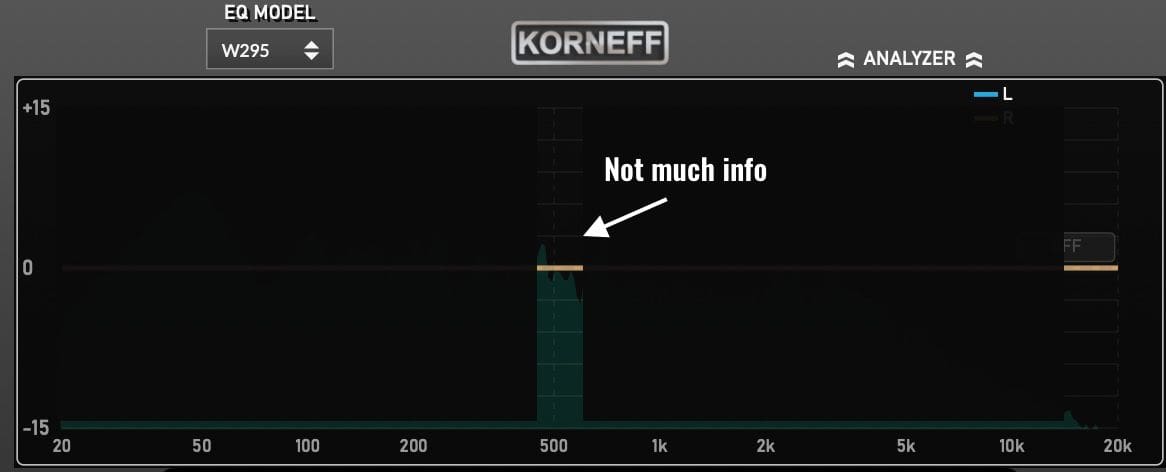
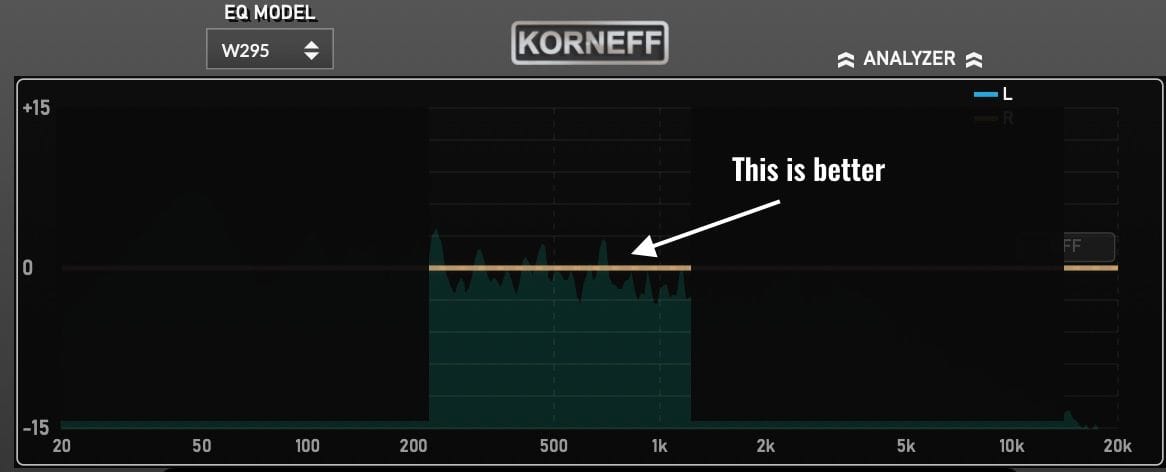
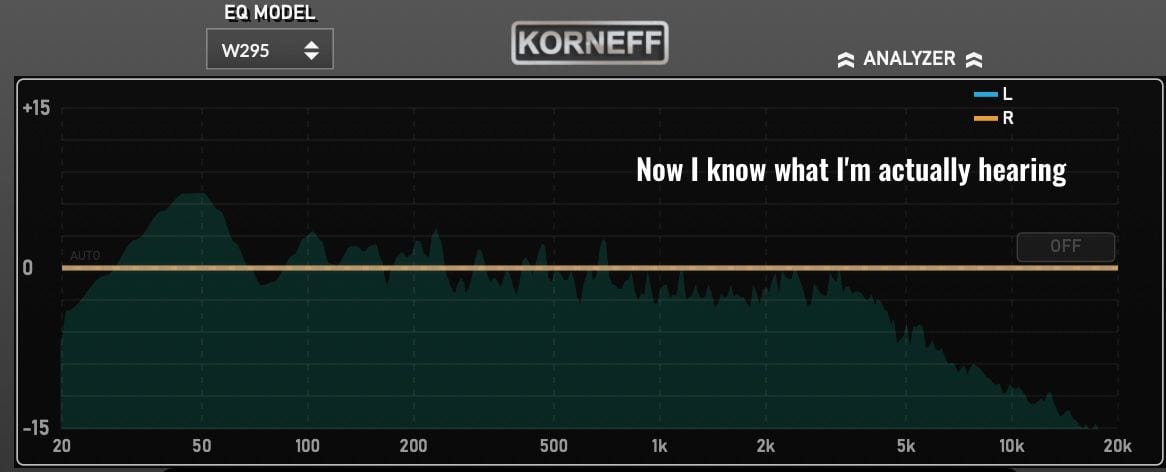
The only way your ear can recognize more frequencies is to spend more time listening.
In practice, your ear needs to hear at least a cycle of a waveform, and usually more than one cycle, to decide what a sound “is,” what frequencies it contains. Your ear needs about 20ms on average to “know” a sound. However, this time varies due to frequency. Your ear figures out high frequencies faster than low frequencies, because high frequencies cycle faster, your ear gets more information in a shorter amount of time. This is a REALLY IMPORTANT CONCEPT. If you get this, you’ll understand the rest.
An analog filter circuit doesn’t figure out what a frequency is like your ear does. And it doesn’t respond to all frequencies the same way. Analog filters use capacitors and inductors to modify frequency response, and the way these work is that the energy of a signal is stored in an electric or magnetic field. That stored energy can pass or hamper a signal depending on its frequency, as it moves through the circuit, and that’s what gives us the response curve. Higher frequencies tend to get through the circuit faster than lower frequencies. If one frequency gets through faster than another, there is a time delay difference between them. These are very short time delays — too short to manifest as a discrete delay like an echo. Instead, as with all very short time delays, we hear them as phase shift. So a signal passing through analog processing, like a pass filter, comes out with a range of phase shifts across its frequencies.
This range of phase shifts is referred to as Group Delay, so if you see that term, that’s what it’s referring to, the phase response curve of a bunch of frequencies—a group.
Let’s equate some concepts here to help you understand all this: your ear taking time to figure out the frequency is like an analog circuit passing through some frequencies slower than others. Time and Frequency are tightly knit together.
NOW… digital processing… you’d think that a digital processor could be programmed like, “lower 200Hz by 2dB,” and it could do that without any phase issues, just like you can tell a digital processor, “Lower the gain of this entire signal by 2dB” by sliding the fader down. But a digital processor can’t single out a frequency so easily, because, like your ear, a digital processor needs time to recognize a frequency.
At any sample point of a digital signal, all there is is a voltage, a number that has no sound or frequency to it. To recognize a sound, a digital processor needs multiple numbers across time; again, this is very much like your ear. And like your ear, it figures out higher frequencies faster than lower frequencies. So, if you feed a signal through a digital processor, and that processor has a response curve to it with different frequencies at different amplitudes, it processes the frequencies as soon as it recognizes them, but it recognizes the higher frequencies quicker than the lower frequencies… and again, the frequencies are phase shifted, just like in our analog example.
Another thought here: any sample point in a digital signal is a number. It is very easy to add, subtract, multiply, divide or do math to that single number. That is what GAIN, or moving a fader, does: math to those numbers. But a digital processor, to affect frequency, needs a bunch of numbers to figure out the frequencies in the first place, and getting those numbers and doing yet more math takes time.
Again, let’s equate the concepts here: your ear taking time to figure out the frequency is like an analog circuit passing through some frequencies slower than others is like a digital processor needing time to calculate a frequency and then process it, and it does this faster or slower, depending on the frequency. Again, time and frequency are tightly knit together.
You’ve probably heard of Minimal-Phase and Linear-Phase filters and Equalizers. Maybe you’ve wondered about the differences. You didn’t? Well, tough, we’ll cover it here anyway. This week: Minimal-Phase; Next week: Linear-Phase.
Minimal-Phase Filtering
A digital Minimal-Phase filter or EQ essentially has the same phase response as the same sort of analog filter or EQ. With both of them, the largest amount of phase shift is located around the cutoff frequency. The digital circuit causes phase shifts in this area, and this is the minimal amount of phase shift needed to do the job. Hence Minimal-Phase.
The better question is, why is the largest amount of phase shift around the cutoff frequency?
Because at the cutoff frequency, the filter goes from doing nothing special—passing signal through—to suddenly having to do work—reduce the amplitude of certain frequencies. The phase changes at that point, and this is the same for an analog circuit.
Now, let’s look at the slope of the filter. If we have a shallow slope, it becomes intuitive that both the analog and the digital filters can first respond to the high frequencies, and then sort of work their way down to the lower frequencies a little bit later.
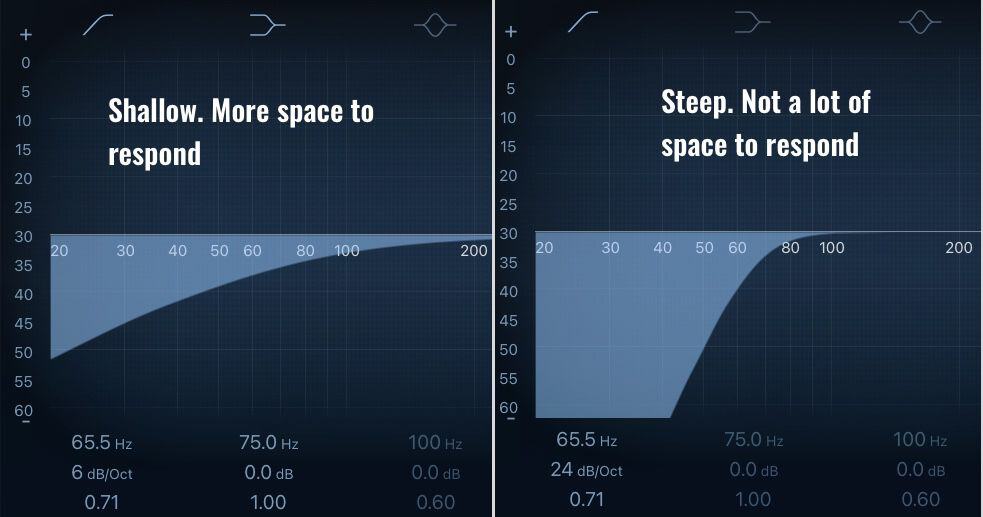
But if the slope is steep, then there is more information to work through in less time, there is a lag, and the phase issues increase.
If the circuit is processing simple information, like a signal with a limited bandwidth, or a signal that is mainly low-end or high-end, it is relatively easy for either an analog or digital circuit to do its job.
What if we cram a whole bunch of frequency information into it in a very short period of time? Like the clang of a bell? Like a very fast transient?
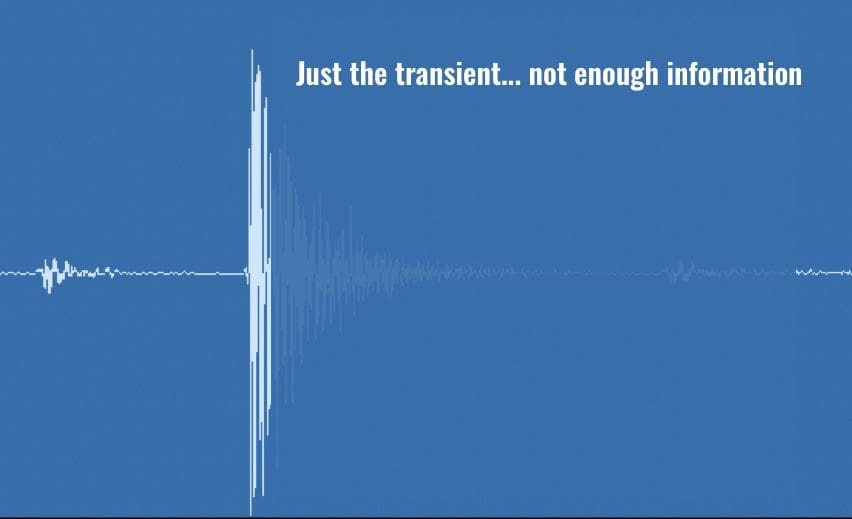
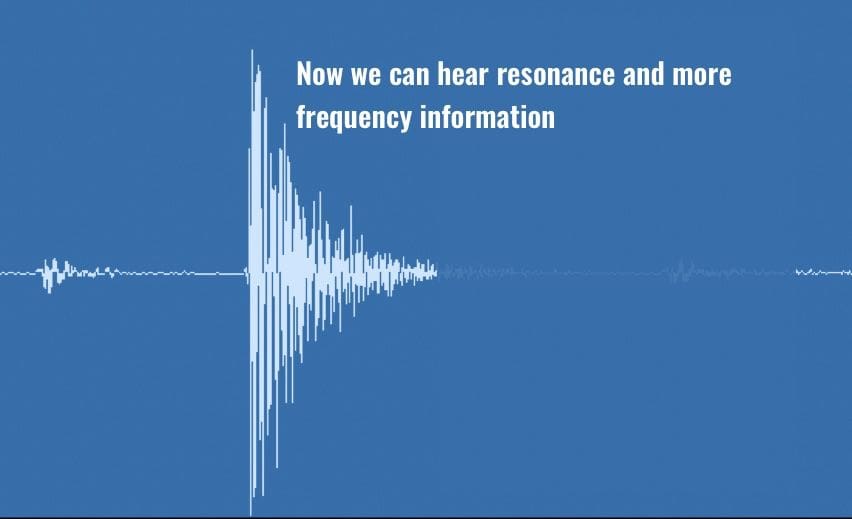
The circuit has to work on a bunch of frequencies all at once, but it has limited capability to do that, so again, it does the high stuff quicker than the low stuff, causing phase issues. So yes, typically fast transients will exhibit more phase issues—the transient “smears” as the highs arrive earlier than the lows.
To really make this bad, slam a fast transient through a pass filter with a steep curve, and the circuit just doesn’t have time to properly respond. It needs more information which means it needs more time.
What does that janky response look like?
In an analog circuit, it sort of gets confused, and rather than letting the low frequencies through evenly, it does it in spurts, sort of like, “Uh, let these highs through Oh Oh oh! Need to let some lows through and Oh Oh Oh more highs and some midrange and Oh OH OH some more lows.” It oscillates. These oscillations happen mainly in the low frequencies, after the transient, and this is called Ringing.
Ringing
What does ringing sound like? First of all, because it is happening after the transient, it is somewhat masked by everything following the transient, so it usually isn’t much of an issue. Depending on the cutoff frequency—like if it’s high, our ears might kinda like it. The transient hangs out a little longer or gains a bit of color. Lower frequency ringing can sound “boingy,” a low-frequency resonance for a moment. Depending on the slope and frequency, it can manifest as a pitchy wobble. All of this is very hard to hear. You might sense, “This sounds off” way before you hear it as a low-frequency pitch wobble.
Digital circuits ring in a similar manner to the analog circuit. It processes the high stuff quickly, squirts out the low stuff after the transient has passed, with just about the same result in terms of effect on the sound.
This is a brainful. The key things to remember are that processing frequencies, whether in your brain or in an analog circuit or a digital algorithm, happen across time, and the speed of recognition/affect/processing is dependent on frequency. The timing difference between the different frequencies results in phase shifts across the signal, but they’re spread out—no shift at some frequencies and more at others as the frequency approaches the cutoff frequency. Ringing is a problem in circumstances where the circuit or processor lags enough that it releases some frequency information late compared to the entirety of the transient. This manifests as an oscillation. It’s hard to hear, and mostly noticed on fast transients with low cutoff frequencies.
Next week, we’ll look at Linear-Phase filtering.