
Happy Monday –
We’re bouncing back across the Atlantic to London this week. Let’s start by listening.
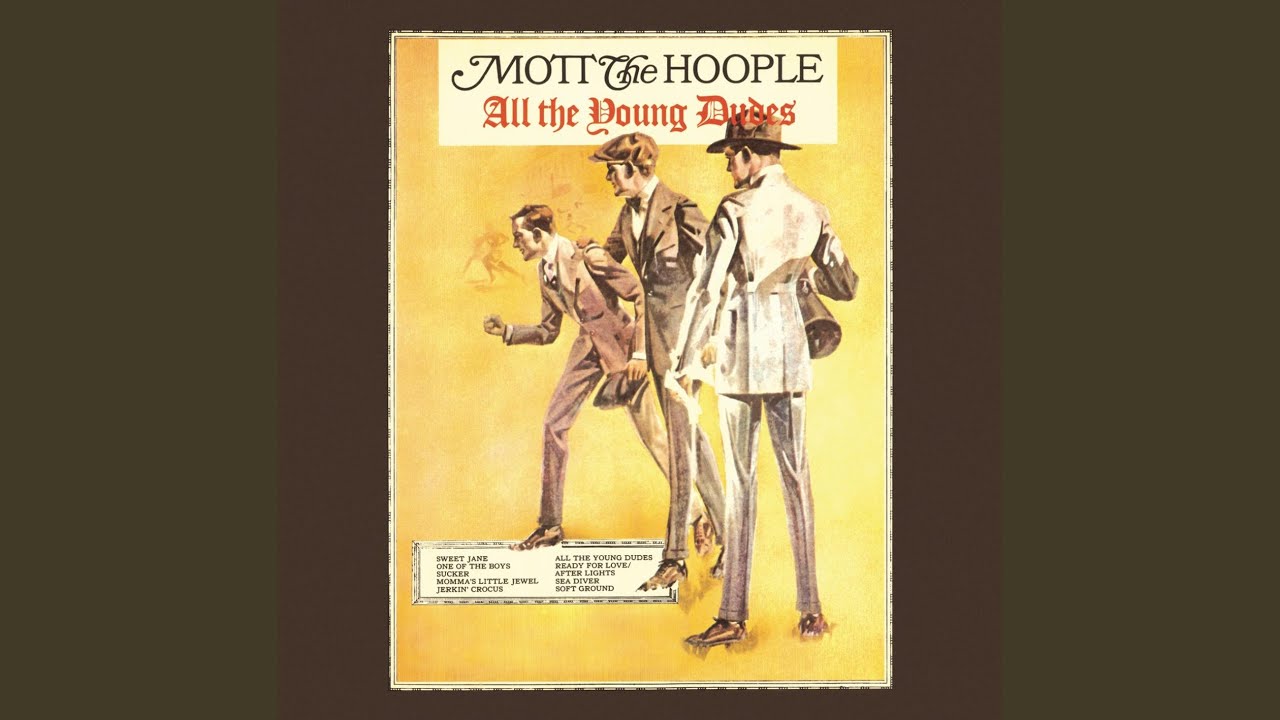
Ready for Love/After Lights
You probably know the Bad Company version of this song. This is the original, recorded by Mott the Hoople at Trident Studios in London in 1972. Produced by David Bowie and engineered by David Hentschel and Keith Harwood, it was on side two of Mott’s breakthrough album All the Young Dudes. You know the hit single All the Young Dudes, you’ve heard it a thousand times, although most of you don’t know who did it or who wrote it. I’ll write something extended on it in a few weeks, but it was written by David Bowie and given to Mott the Hoople in an attempt to stop them from breaking up.
There are some fun things to listen for. The links are cued to what I’m pointing out for you to hear.
Check out the separation on the toms and the drums in general. The drums, played by Dale Griffin, are dry, but there is a space to them that seems to go back.
The engineers are also playing with the drum levels throughout the mix. Listen for the hi-hats getting louder on the pre-choruses. That might also be a hi-hat overdub… actually, we could have a poll on this.
After the chorus there’s a short break, and at about 1:40 you can hear the hit hat loud and slightly to the left seemingly pan back over to the right. Did someone make a mistake in the mix? Is that loud hi-hat an overdub, or a lift in the mix?
The lead vocal on the verses is the song’s writer, Mick Ralphs. On the choruses, it’s Ian Hunter. David Bowie is on saxophone.
The electric rhythm guitar is hard left, with what sounds like a tiny bit of room sound to hard right. The part is doubled with reverse panning on the choruses. What a great guitar sound—huge and defined. There’s also lead parts, played by Mick Ralphs, that sound like the mic is pulled back a distance.
Listen carefully on to the right channel: there’s a guitar part during the verses and the pre-chorus that sounds like a very thin acoustic guitar. I think it’s an electric guitar that’s not plugged in and they mic’d the body. It’s pretty clear here, at about 1:15 on the right channel.
Here is a spot at 2:40 where it distinctly sounds like two hi-hats, and the mic’d electric guitar body is very clear. Earlier it sounded like one hi-hat. Now I think it’s two…
There’s an electric piano part that turns into a lovely solo at around 3:00. It could be played by Ian Hunter or perhaps organist Verden Allen.
Ready for Love elides into an instrumental called After Lights at 4:20. There’s a break featuring some high, haunting vocals, and then the band slow jams its way out. This is probably Mick Ralphs’ best lead guitar work, and the bass… great, melodic playing complete with harmonics by Pete Overend Watts. Bowie gets in with some wispy sax. The whole thing is moody and lovely.
Listen for Mick’s lead part. It sounds like it was recorded to two tracks, with one mic close and another farther back, and perhaps the farther mic through a tape delay. The parts pan all over the place—you might need a better source than YouTube and a set of headphones to hear why I think this is two separate tracks.
One last favorite moment. At about 5:15, drummer Dale Griffin switches from 8th notes on the hi-hat to 8ths on the ride, and it is GORGEOUS. The ride is a shimmer, and the song seems to relax out like a drive at night in the desert. It reminds me of this other favorite moment in recorded music. I know you’ve heard this.
Honestly, these things make me cry. These beautiful moments on records. I could lose myself forever in these moments.
Here’s a link to the whole All the Young Dudes album.
Sound Techniques at Trident
All the Young Dudes was tracked on a Trident A-Range and mixed on a Sound Techniques A-Range. Confused? What’s with all these A-Ranges?
Trident opened in 1968, with a Sound Techniques A-Range console in the control room. I wrote a full history of Trident and Sound Techniques. Read it at the link below.
https://korneffaudio.com/sound-techniques-and-trident/
I was going to write more but I’m all weepy now! I’m not kidding.
There are so many wonderful things to hear. I hope you all take care of your ears.
Warm regards,
Luke