Happy Monday –
A mixed bag. Some on that dopey video—the last I’ll write on it, a bit on the AIP, something on Slew Rate, and the modulation trick y’all asked for.
Why the Dopey Video is Under Our Skin
I’m still thinking about that Jim Lill video. Dan and I have been discussing it, along with the rest of the pro audio world, and it bothers both of us a lot.
It bothers Dan because it presents itself as being scientific and grounded in testing, and it simply isn’t. The tests aren’t anywhere near rigorous enough, probably because the creator of the video doesn’t have a deep audio engineering background or any engineering background—electrical engineering, mechanical engineering, any engineering really. That is not to say he needs a degree with an E in it, but one needs to know somewhat about how these things work. Dan has that deep engineering background, from going to school, building his own equipment, designing his own software, from thousands of hours in the studio making world-class records. The statement in the video that pissed Dan off the most was when Jim said something to the effect of, “No one has ever done this sort of thing before.” Dan’s comment: “Are you kidding?? This is what engineers at audio companies do ALL DAY, since forever.”
The video bothers me because the video is charming, convincing… and wrong. I love teaching. It’s been something I’ve been doing since my teens—I started out teaching guitar. Throughout my audio career, I was teaching assistants, bands, or in a college classroom (which was where I met Dan). And I think there’s an obligation when teaching not only to get the information across in a fun manner, but deliver true, accurate information. Now, there might be simplification involved, and metaphors, and explanations that aren’t thoroughly scientific, and I do that all the time, but at the base of things, I don’t present information that is factually wrong, nor do I back it up with data that is wrong, or a testing regimen that is half-assed.
This leads to the following question:
How Much Does One Need to Know?
You need to know enough to do the work you want to do, enough that you can make confident, smart decisions, and be creative and experimental in a manner that will probably yield a positive result.
You don’t need to know as much as Dan or Paul Wolf. But you do need to have a concept firm enough in your head that you can explain it to someone who knows less than you, and they understand it, and to someone who knows more than you, and they say, “Yeah, that’s the basic idea.”
Is what you know useful to you? You don’t need to know that there are electrical fields pulsing around everywhere, or that there’s asymmetrical clipping going on, but do you have an idea of what is happening when you’re setting a level, and why you’re parking things around 0 or -18dBFS? Do you get what is going on?
What is the next thing I need to learn to get better at this?
I’m in the process of reorganizing our educational content. I’d love your feedback on how I can do this better, so it is easier for you to find and navigate. Here’s where I’m at so far:
The Science Behind Setting Levels
This is in addition to the four courses I set up, and the hundreds of New Monday and Blog posts… Ugh! I have to add Search this week!
The Amplified Instrument Processor
Last week I wrote a little bit about the Amplified Instrument Processor because it has pre-amp emulation, courtesy of something called…
The Proprietary Signal Processor
The PSP is a saturation modeler. We recommend this is the first thing you mess with. Why? Because it’s a bit like choosing which console you are going to mix on, and that’s a decision that affects every decision you make further down the effects chain. You can think of it as “dial-a-saturation.” Tube, Tape or Mid-forward Solid State. The Transient Response knob can be adjusted from Bright to Dark. This is kind of a Slew Rate control.
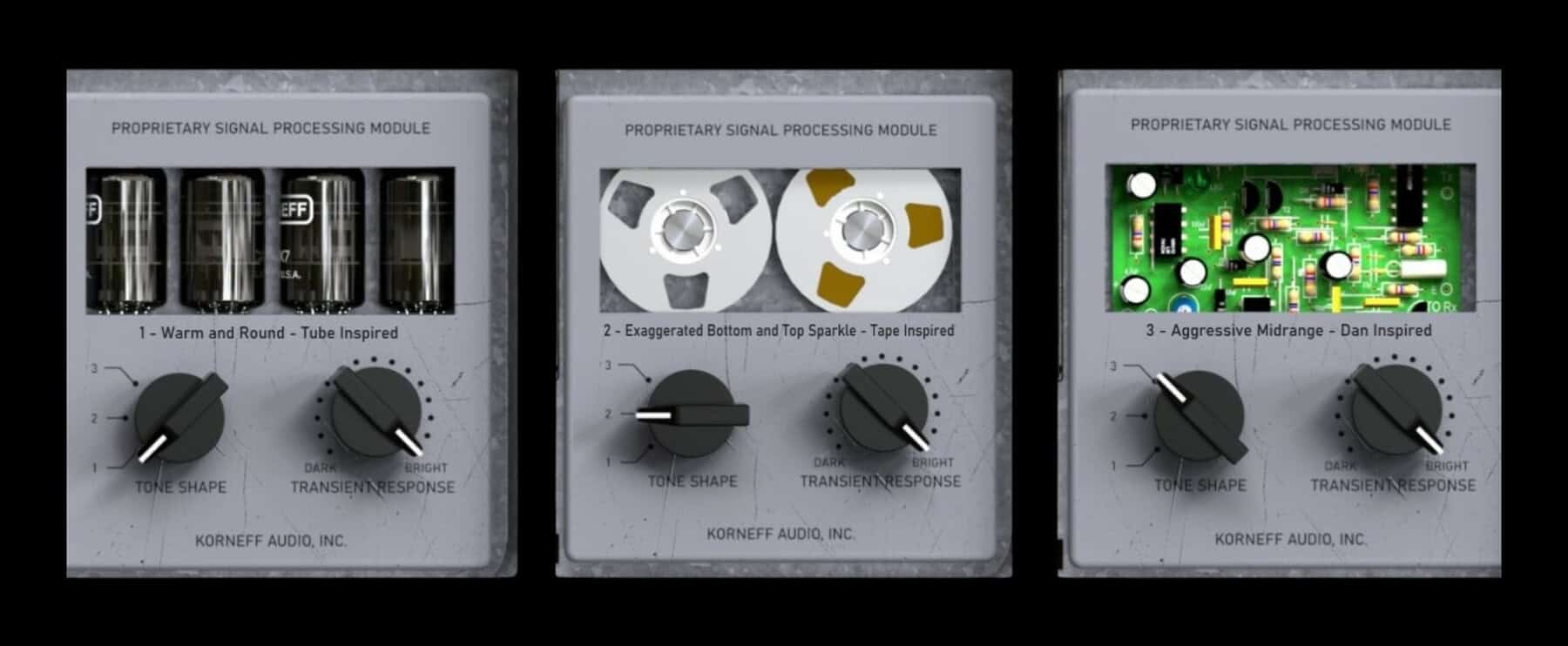
What is Slew Rate? Slew Rate is how fast a circuit can deliver power, the maximum rate at which a circuit’s output voltage can change. Low slew rate = smeary transients. Set TRANSIENT RESPONSE to dark and the transients smear and the overall sound is duller and less bright.
Why?
What is Slew Rate?
You have a sink, and you have to fill it with water, and it takes a bit of time to fill up that sink. Think of a waveform as having a positive side—a positive sink, and a negative side—a negative sink. To correctly reproduce the waveform, you have to fill up the positive sink, then drain it, then fill up the negative sink.
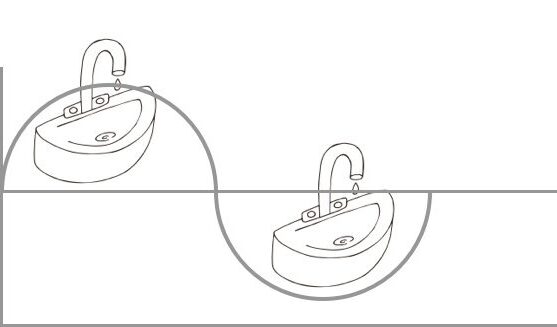
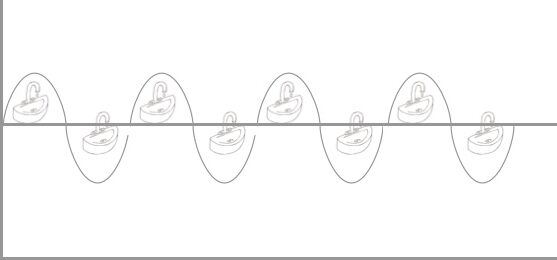
Think of frequency not as cycles per second. Think of it as sinks per second. At 100Hz, 100 positive sinks and 100 negative sinks need to be filled up and drained in a second. As frequency goes up, more sinks need to be filled and drained per second.
Amplitude is how big each sink is—how much water (power) you have to get into it.
As frequency goes up AND power goes up, it becomes clear that you need to get a lot of water in and out of a lot of sinks very quickly. Slew rate is the hose you’re using to fill and drain the sinks. You don’t have an infinite hose. It can only move so much water over time.
What part of a sound has a lot of power at high frequencies?
Transients.
What happens when the hose can’t deliver enough water fast enough to accurately fill up and drain the sinks? Well, the high-frequency sinks get skimped on—they don’t get enough water to fill before they have to start draining to get to the next sink. What would a waveform look like if it didn’t get enough power? It distorts.
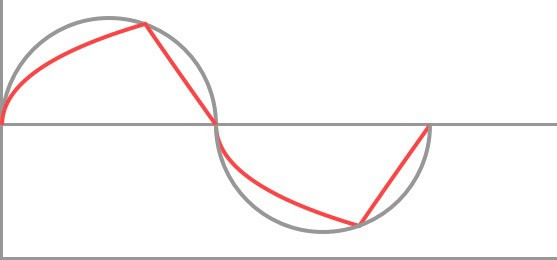
It starts heading towards a triangle wave. And remember, when we reshape a wave we generate different harmonics. How much would you hear this? Depends on what you’re sending through the circuit, but it is definitely audible, especially things with transients.
Tape and Tubes tend to be a bit “laggy” on transients, smeary. Solid-state circuits are faster, especially modern designs.
Turn TRANSIENT RESPONSE to the left to distort those transients and approximate different slew rates. Download an AIP Demo and play with it. Hear it for yourself.
Two other thoughts: once you have your mix going, you can switch between the three PSP settings and adjust the TRANSIENT RESPONSE to change the way the part “sits” in the mix. It is subtle, but it is audible.
The Hockey Stick Trick
A bunch of you asked for the modulation trick I mentioned last week, and this is it. I got this out of a book called Sherman Keene’s Practical Techniques for the Recording Engineer: A Streamlined Technique for Speed, Accuracy and Documentation. By a guy named Sherman Keene. Great book.
So, here is how I did it the couple of times I did it—I used it to get guitar sounds.
You need two SM57s or something similar—a cheap, rugged mic that you don’t mind breaking. And some mic cables. And two channels of pre-amp or channels of a mixer.
Two assistants or guys from the band.
Set up a guitar amp on the edge of a space. You need at least a 7”x7″ area in front of the guitar amp.
Have one assistant lie on the floor, flat on his or her back. Hand them an SM57 plugged securely into a cable. Give them about 3’ of slack. Have them swing the microphone in a circle so the mic passes about a 1’ away from the amp. The mic should be making a 5’ in diameter circle. The bigger the better. You can get closer to the amp if you wish, but if the mic hits it… This is why you use an SM57.
Give the other assistant a big stick, like a broom handle. A hockey stick works the best because of the blade. Tape and tie off another SM57 on a cable to the blade of the hockey stick so that the mic can swing in a circle about 5’ in diameter. The blade points down at the ground. The second assistant stands somewhat over the first assistant, maybe down by their feet, and reaches out with the hockey stick to swing the microphone in a circle. You want the two circles to roughly have the same diameter and central pivot point.
Have the two assistants practice swinging the mics. They will manage to bash the mics together and whoever is on the floor is going to hit himself a bunch. The guy with the stick will hit the guy on the floor as well. Sucks to be on the bottom.
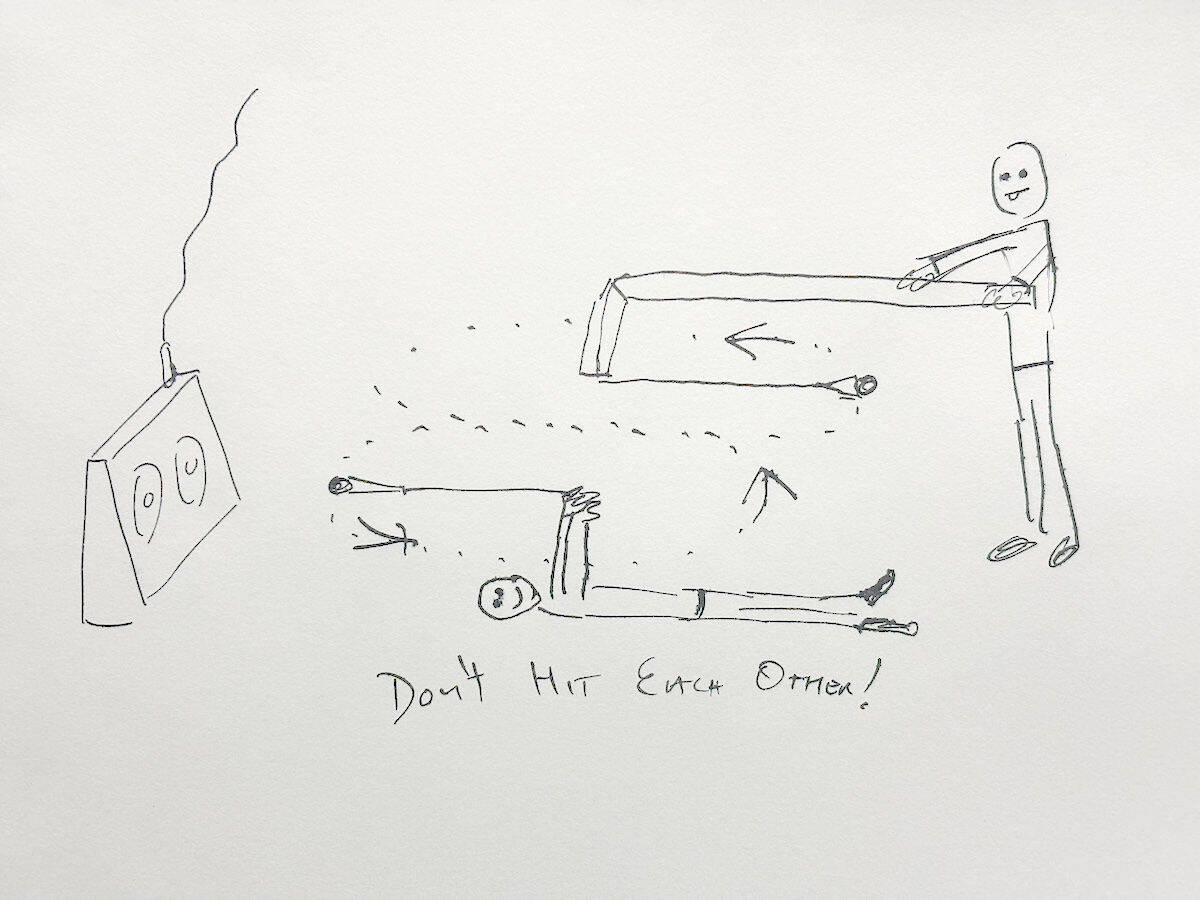
When the laughing stops and the assistants learn not to hit each other, bring up the channels, feed them to two tracks of your DAW and record. Experiment with different spin rates and directions—the two can swing both in one direction or in two different directions.
The net result… it’s absolute insanity. Pan it wide and it’s flanging and phasing and panning all at once. Like being inside a Leslie Cabinet, mounted on the speaker.
You could do this in the middle of a room and flange an entire band, or a piano, or surround the swinging mics with a bunch of singers for a wild effect. You can also displace the swing motion to the vertical plane—the two assistants swing the mics in a floor-to-ceiling path. If you swing mics in the vertical plane, you can have more than two mics. An added bonus.
Anyway, this is one of the most fun things you can do in the studio and it usually comes out very cool-sounding. It’s also great as a morale booster when the band is in a foul mood.
Let me know if you try it, you maniacs!
Warm regards.
Luke