
I’m going to start writing weekly tips. Starting right this moment. Let’s look at the term Knee, and how it applies to compression.
When the signal crosses the threshold in a compressor or an expander, the gain reduction circuit kicks in, lowering the level of the signal. Compression 101, right? How quickly compression kicks in is controlled by the attack, and how aggressively it kicks in is controlled by the knee.
A soft knee gradually applies compression, and as the knee gets harder, compression is applied more forcefully. What the hell does that mean? Let’s break it down.
Ratios and Knee
2:1 is a very low compression ratio; 10:1 is a much higher compression ratio. Remember, with a ratio, think of the colon as the threshold: the first number is how much goes in over the threshold; the second number is how much comes out. With a soft knee compressor, as the signal goes over threshold, the compressor might apply 1.5:1. The more the signal goes over threshold, the higher the ratio the compressor applies. In other words, the signal has got to go a lot over the threshold for the compressor to apply its full ratio setting.
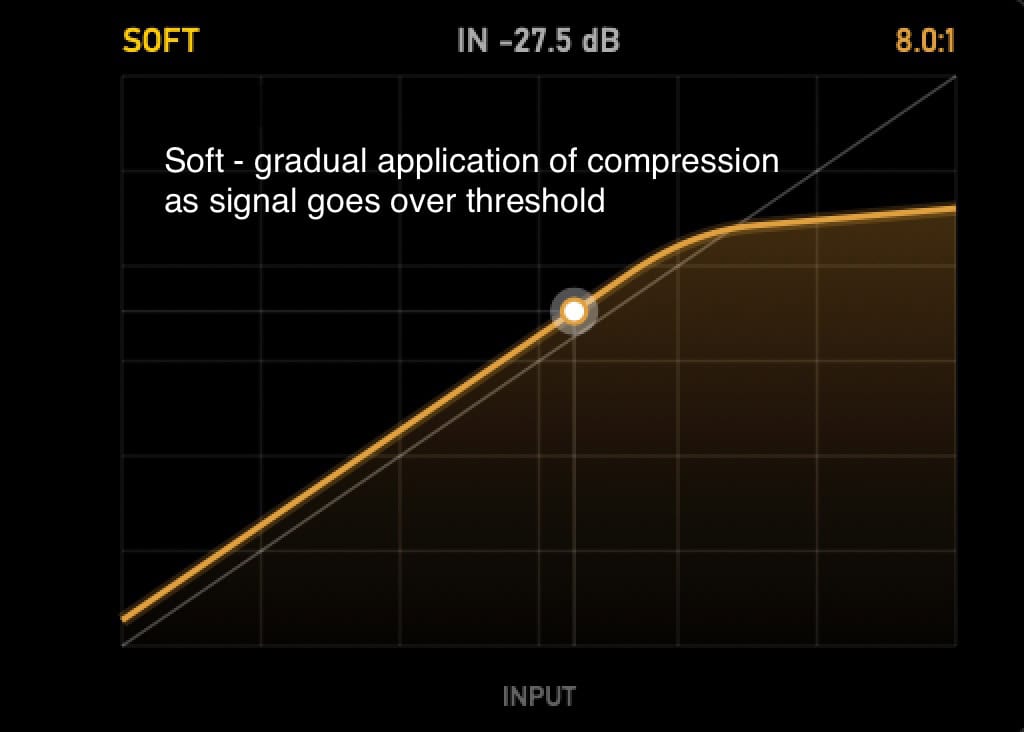
Let’s say we set the ratio to 8:1 on a soft knee compressor. If the signal goes a little bit over the threshold, the compressor applies a ratio of like 1.3:1. The more the signal goes over the threshold, the higher the ratio the compressor applies until it hits the full 8:1. Think of it like a gradually bending leg.
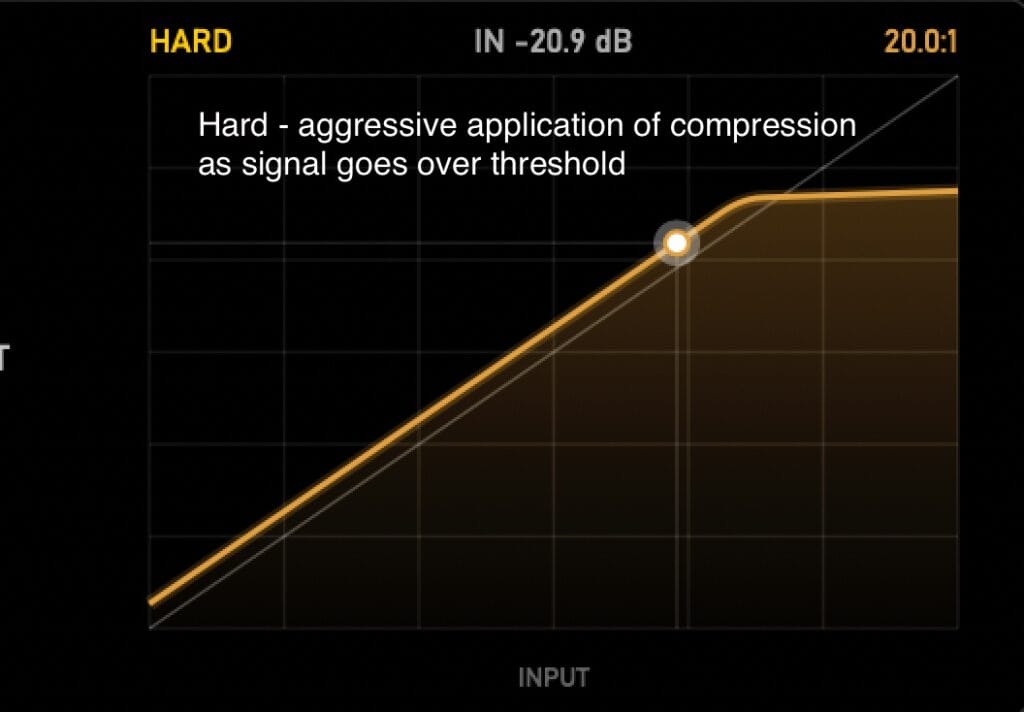
If it’s a hard knee compressor and we set it at 12:1, the moment the signal goes over threshold, even a little bit, the compressor smacks into it at 12:1.
Walking Dogs
You’re walking a dog with a leash. If the dog moves and you hold the leash tight, the dog gets jerked. Every time Charles Barkley (I think that is the best name ever for a dog) moves, even a little, you hold the leash tight. There’s no give. It’s just YOU WILL NOT MOVE. Eventually, your dog wants to kill you, because you’re a Hard Knee Dog Walker.
A Soft Knee Dog Walker is gentle. The dog moves, and you apply a little pressure. The farther it goes, the more pressure you apply. The amount of pressure you apply is related to how far the dog goes. You’re trying to train the thing, not snap its neck.
This is all well and good, but what the heck does knee sound like?
How Knee changes the sound of a compressor
A critical area in terms of the sound of a compressor is what happens when the signal crosses the threshold. Will the attack let the transient through and increase punch? Will the attack cut the transient off? Will the waveform distort? The knee is a big factor.
A soft knee tends to make compression less noticeable. There’s less punch, less clipping and deformation of the waveform. Soft knee typically isn’t as punchy as hard knee, but if the attack is slow and you slam a lot of signal through it, punchiness will increase.
Hard knee is the opposite. It is more noticeable, has more punch, and also can do more damage to the waveform if you’re using high ratios and pushing a lot of signal through it.
When to use which Knee Setting
When you don’t want to hear compression, use soft knee. So, on vocals, and acoustic instruments. When you want something gentle and unnoticeable, think soft knee.
Use hard knee when you want punch and maybe some distortion—when you really want to hear the signal get pummelled. Hard knee on drums is killer. Often mix bus compressors are hard knee.
Double Compression (Serial Compression)
On something like a bass, I compress first with soft knee and then follow that (serial compression) with something hard knee. In general, if you don’t want to hear compression but you really need to constrain the dynamics, think soft knee followed by hard knee in series, one after the other.
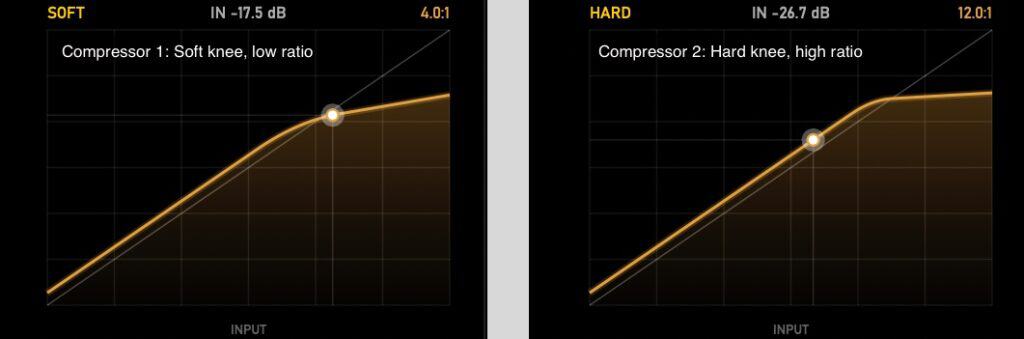
You can hear all this on the KA1776 Limiting Amplifier. 4:1 and 8:1 are soft, 12:1 and 20:1 are hard. Download a demo and have a listen.
The threshold can shift up or down depending on the knee, so when you’re switching knee, and even ratio, often you might need to tweak the threshold control, or in the case of the KA1776, the INPUT level.
Last quick thing: note that low ratios are always sort of soft knee, and really high ratios are always sort of hard knee.
The best way to learn this stuff is to practice and listen. SO… get in the studio and get mixing…!
Warm regards,
Luke