Korneff Tips 08: My Overheads Want to Kill Me
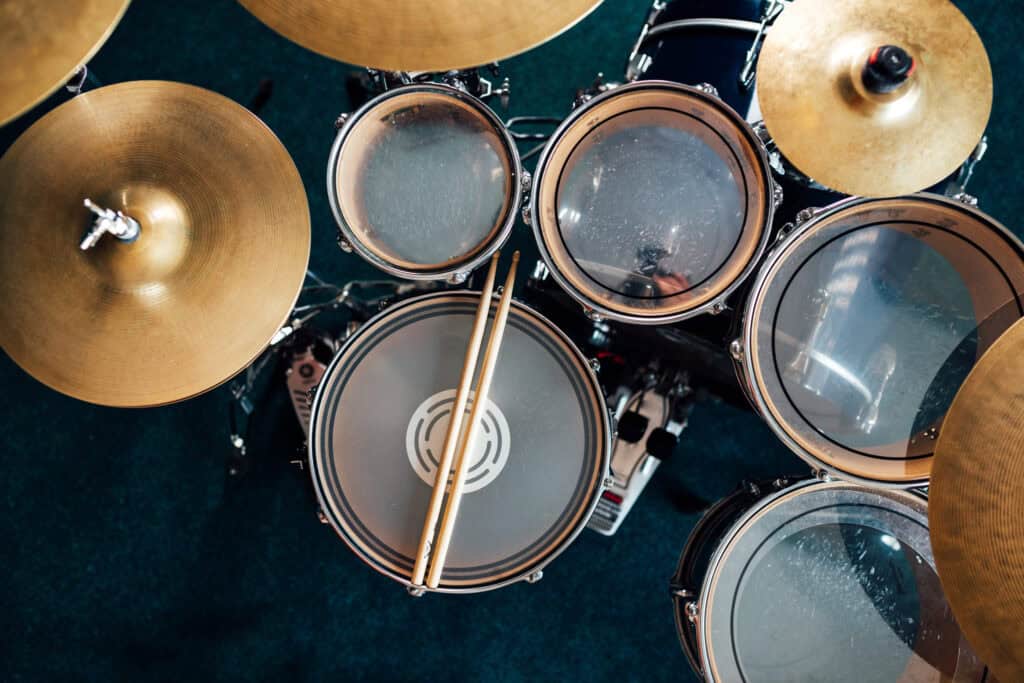
I'm down on overheads because I'm mixing something that has overheads recorded such that they're verging on useless. Not enough hihat. Crash cymbals that are incredibly harsh—a solid wall of SHHHHHHHHEEEEEEEE that goes out into the world with the express purpose of shaving the hair inside your cochleas.
Today's tip is a response to what I'm stuck working with. How would I have prevented this in the first place? How do I fix it now?
So I mainly have questions that you can ask yourself, with some answers from me that you can ponder, as you work out your own solution to the situation in front of you.
In the Studio
Do you have a lot of decent mics, and by that I mean condensers or ribbons?
You have a lot, you can do whatever you wish. Just one or two? Well, if just one, don’t feel bad. Lots of records these days have basically mono drums. If you only have a few decent mics, don’t worry about stereo. Good mono is better than shitty stereo.
Do you have a decent room?
Do the drums sound good in the room or do they sound like ass? Does the room sound good or awful? If you have a decent room, you can probably use your overheads to capture a picture of the entire kit. If the room sounds bad, you’re better off thinking of your overheads as cymbal mics and getting as close to the cymbals as possible.
How low is the ceiling?
Low ceilings have a lot of reflection and it all gets thrown into the mics. High ceilings are better. Kill the ceiling with a blanket if it is low. It will cut down on the cymbal high end—you want less of that bouncing around.
From last week: wrap the kick up in a blanket and absorb all those within kit reflections—remember, the kit reflects itself.
How dense is the music?
If you’re making metal or something with loud guitars, you’re really looking for drums to punch through the thickness of the mix, and that means individual mics on everything. Your overheads become cymbal mics, and don’t forget to mic the hihat.
If the record is alternative or jazz or something with breathing room, and you’ve got a decent room, you can capture the whole kit with the overheads and then, if you’ve got the extra mics, spot mic the individual drums for added clarity.
What about Glyn Johns?
The Glyn Johns method, if it ever was one, or the Recorderman Technique—are ways of micing entire drum kits using only three or four mics. The Beatles, The Doors, The Stones, Jimi Hendrix, The Who, Led Zeppelin, etc., for the most part used variations on these minimal micing systems. But they don’t work that well for dense, modern records. "But," you argue, "Keith Moon played crazy! John Bonham had great fills everywhere." Go back and listen: there’s one or two guitar parts and that’s it. Tell me you can hear the drums on Four Sticks clearly. These are background parts. And don't forget those records were cut in rooms that to this day are some of the best acoustic spaces in the world by the best engineers in the world with the best drummers of all time. And the philosophy was different. There was way less emphasis on drums back then.
Those minimal systems work well if you’re doing something more alt and kinda weird, where the drums are more about character. Where you’re going to slam them through a Level-Loc and get some lo-fi vibe out of them. Fine. Do what you like. But you’re not making a Pantera record with four mics. It ain't gonna happen.
Stereo Patterns
One mic in the middle pointing at the snare is mono. You’ll lose things out towards the left and the right. Perhaps if you’re not getting enough hihat do a take where the mic is cheated towards the hihat. And then record tom rolls and ride cymbals while cheating the mic that way a bit. Don’t move the stand, just tilt the mic a little. Once you’re done, splice those parts together. Or use two mics.
XY stereo is common. Two mics in XY over the drummer's head point a bit left and right at the cymbals so you’ll get more left and right. BEWARE THE CEILING. Low ceiling will kill ya. X-Y is ok with a low ceiling if stereo is what you want. A low ceiling generally means "treat your overheads as cymbal mics."
ORTF is a French stereo micing system. It spreads the stereo pair out and I used this a lot on drum sets. In a good room it sounds great.
M/S gives you a strong center signal and stereo information and a lot of room sound. With a low ceiling, don’t use it. If you aren’t getting enough of the left and right, adding two other mics far left and right will help, but watch the phase!
Spaced Pair, which is to say two mics placed far away from each other. This is stereo in the sense that there's stuff on the right and the left, but over something as small as a drum kit, it's really closer to cymbal micing.
Cymbal Micing: Put an individual mic on each cymbal, or pairs of cymbals. Or one left, one right, one on the hihat, one on the ride. When things are dense and the room questionable, cymbal mic it. The recording I'm mixing should have been cymbal mic'd, with each on its own track so they can be fixed individually and wouldn't have to resort to editing and other gyrations.
Types of Mics
Whatever ya got. I tended to use small diaphragm condensers, but things like 414s work well, U87s work well, a C24 in the center in M/S with a pair of SM81s as the far left and right work well. Ribbon mics smooth out overly bright cymbals, but beware the ceiling—they’ll pick up reflections from it, so if the room sucks it won’t sound that good.
I just mentioned a bunch of expensive mics you might not have. In general, large diaphragm condensers will tend to be more sensitive and get more bottom end. Small diaphragm condensers will pick up less lows. In a shitty room, condensers will pick up more room sound than dynamics or ribbons. It's about sensitivity, not polar pattern. If the room is crappy, dynamics might be the best choice. Like RE-20s for overheads—they have wide frequency response and don't pick up a lot of room. In fact, a pair of RE-20s would be a good thing in your life. It's that or move to a decent room!
If all you have is dynamics, then use dynamics. If all you have is SM57s, then use SM57s. Move them around and get the sound you like the most.
Inbound Processing
I liked very fast mic preamps with overheads, something with a high slew rate. I typically don’t compress overheads to tape, and depending on how they’re going to fit in the mix, I roll off the bottom with a pass filter. Overheads can get very humpy sounding if they’re not in shock mounts or somewhat isolated and high passed.
Compression on overheads is very problematic. A lot of it depends on the touch of the drummer. What I’m running into with these badly recorded overheads is long sustained crashes that add a ton of harsh brightness to the mix. This stuff is very hard to clean up. And compression can just make that so much worse. A fast compressor will remove the ting, the attack on the cymbal, and bring up all the sustain of the cymbal. Really, with cymbals, you're looking for those things to die out pretty quickly. I wouldn’t compress overheads going in, and be very careful with compressing in the mix.
In the Mix
I run into a couple of things dealing with overheads. The first is harsh awful sounding cymbals.
You can try to EQ this. If it’s not too terrible, you might be able to do something, but for the most part, I find trying to EQ that stuff out as an exercise in futility. However, if you wanna try it, there’s no better tool than the Insufferable Midrange Filter on the Korneff Audio Amplified Instrument Processor. The AIP is designed for guitars, but it works well on drums, especially the IMF.
Throw an AIP across the channel.
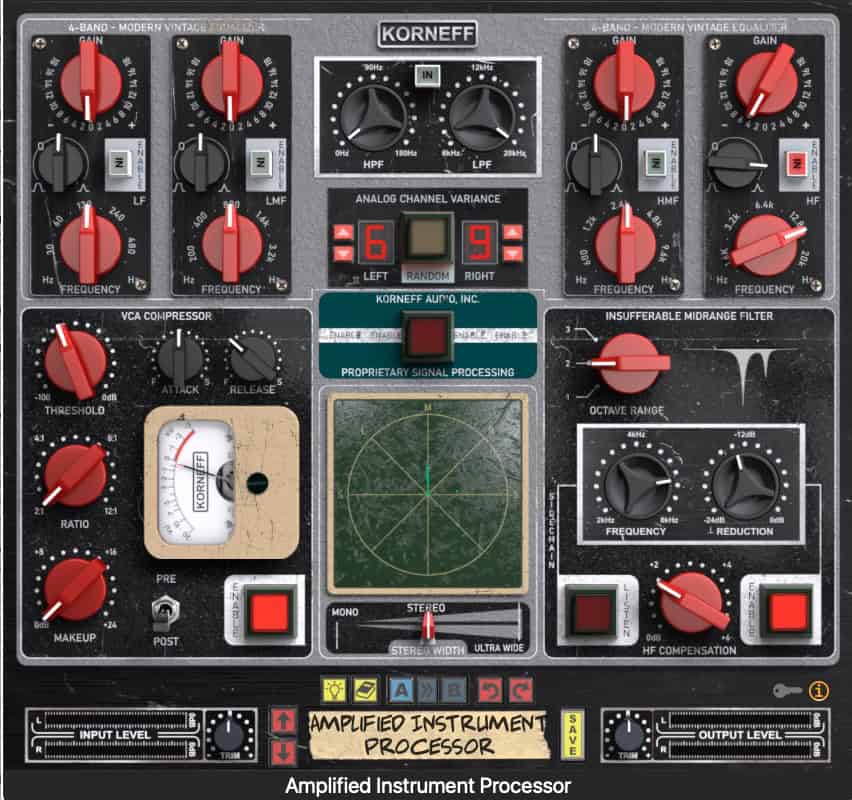
The Amplified Instrument Processor. It's the Swiss Army Knife of plug-ins.
There’s a smart way and a dumb way to find frequencies that you don’t want in your mix.
Here’s the dumb way: Turn on an EQ, boost it a bunch and then sweep around 'til you hear the bad sounding thing, and then you cut there. This is dumb. Sometimes it’s the only way to find offending frequencies, but it’s dumb.
It’s dumb because generally when you’re boosting a lot and then sweeping around almost everything sounds bad, especially in an already bad sounding high end. Conversely, if you’re boosting hard enough, sometimes almost everything sounds good, especially if you're using the EQ on the AIP, which almost always sounds good.
Doing a lot of boosting in the highs also changes the sensitivity of your hearing for a bit. If you’re going to be doing stuff like that a lot, you’re gonna have to rest a lot during your mixing sessions to recover some of your balance.
Lastly, it’s just dumb. It’s like where is the boat leaking? Let’s have it leak some more so we can find where the hole is. You’re going to sink the boat. It’s just dumb.
The smarter way is harder, of course. That’s usually how it is.
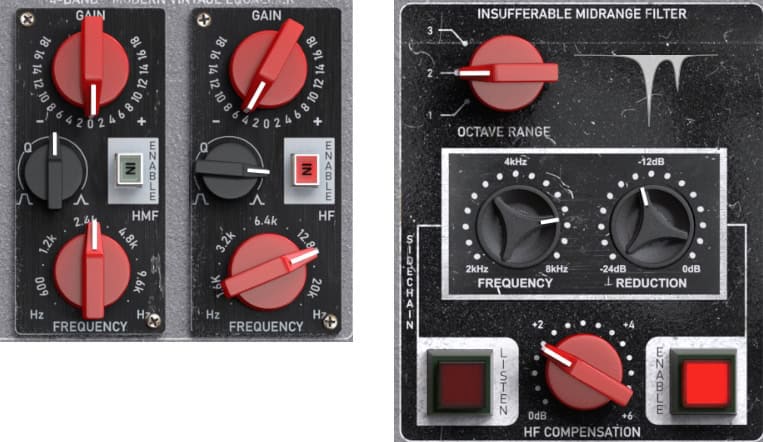
EQ and IMF settings on the AIP for cleaning up cymbals.
Cut. Cut a bunch and if you have a bandwidth (Q) control, open up your bandwidth a bunch and now sweep around. You’re listening for a spot where the harshness kind of goes away. Tighten up your bandwidth and fine tune in the area until you’re pretty locked onto the harsh sounding frequencies, and then back off the amount of cut a little bit until it sounds bad again. Take the time to fine tune this. Do this in solo and then in context with the rest of the mix.
Same process on the IMF. Set OCTAVE RANGE to 1, which is a single sharp notch right on the selected frequency. Cut -18dB and sweep around the frequencies. If you find a spot where it smooths out, try OCTAVE RANGE 2 or 3—these add additional notches an octave above and below the selected frequencies. What sounds best to you? If you’re cutting it heavily and the whole thing is a little bit dull, use HF COMPENSATION to get the high-end back—this is a high shelf boost EQ. You can do all this in solo then throw it back in the mix, and see if it makes a difference. If the part is a little lost or sounds a little dull, and it just should be brighter, perhaps pinch the fader up a little bit or restore some of the highs, using the restore high button.
The AIP also has Frequency Dependent Reduction, which is basically a frequency dependent compressor. Here I'm using it as basically a de-esser and going for yet more reduction in those overhead highs.
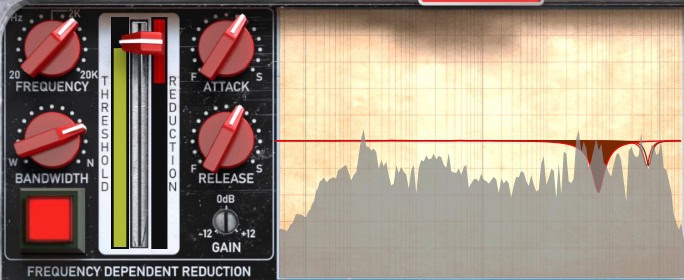
Frequency Dependent Reduction settings for more cymbal clean-up.
If you're doing a lot of cutting in one area, another thing to do is just LOWER THE TRACK IN THE MIX. If you're lowering the track in the mix or cutting toms out of it, it was simply not recorded well and you'll need to do something more extreme.
All the EQ cutting couldn't save these overheads. This will have a part two: next week, some radical moves on the overheads in the mix.