New Monday #106
Happy Monday!
We debuted our next plug-in at NAMM. It's in beta testing right now and will be out in a few weeks. It's a reverb, based on Sunset Sound Recording's iconic Chamber One. In the next few weeks as we head towards the release, I'll give y'all some details and technical background.
Reverb Chambers
For most of human history, the only way to get reverb or echo was with nature—having a big space and bouncing sound waves off the walls and ceilings. Like a canyon. Or a cave. Or the Parthenon. Or a cathedral. Or a concert hall. Maybe a mall. In 1947, the ever brilliant Bill Putnam Sr. put a speaker and a microphone in the tiled bathroom at Universal Recording in Chicago to create what he called an echo chamber. Here's the first song ever recorded with artificial reverb on it.
It wasn't a difficult idea to copy, and most major studios soon had reverb/echo chambers in spare rooms or down in the basement. You send a signal from the console, using a send, to an amplifier and a speaker. That sound goes bouncing around the room and feeds into two microphones (because stereo) which are returned into the console. How much reverb can you get? It depends on the size of the space and the reflectivity of it.
Salvatore "Tutti" Camarata opened Sunset Sound in 1960. It had one control room and studio, with an attached, purpose-built reverb chamber. It was (it still is) fifteen feet long, and about five feet wide and 5 feet tall. It's solidly constructed, finished with a very reflective paint.
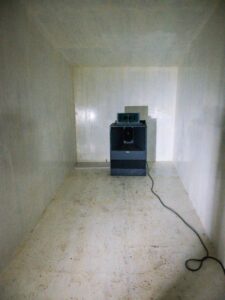
At one end is a speaker—an Altec Lansing A7, and at the other, by the door, is a pair of RCA B77 ribbon microphones. The mics are wired to the wall and ceiling so they won't fall if the stands are bumped or there's an earthquake.
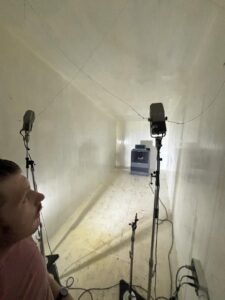
The chamber is sealed by an insulated door off an industrial refrigerator—a meat locker. Then that has a removable piece of wall over it.
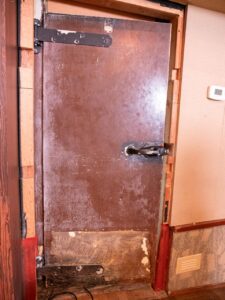
Chamber One is heard on thousands of recordings, from Disney movies to Led Zeppelin to Prince to right now. It is iconic.
Initial Reflections
Our impulse response measurements of Sunset Sound Chamber One, which we did in November 2025, show a decay time of 3.5 seconds. For a small room it has long decay. And that can be an issue.
It's an issue that can cause a reverb chamber to sound unnatural. It has to do with initial reflections.
In a concert hall, let's say the first wall is forty feet away from the sound source. So, the sound travels out, bounces off the wall and then heads for someone's ear (to a microphone). Let's say it is about an eighty foot journey—to the wall and back. Sound travels a little bit faster than a foot per millisecond, so roughly 70ms will pass before that initial echo is heard. Reverb chambers in studios are much smaller—Sunset Sound is 15' long by 5' wide by 5' high—its initial reflections are under 20ms. And this is confusing to our brain a bit. It hears the reverb coming quickly, so our brain assumes a small room, but then the room sounds huge. Little brain goes, "Is the space small or big??"
We can fix the issue by delaying the onset of those initial echoes. In the old days, you'd stick a tape delay in front of the speaker and add some time—30 ms or so—and the reverb would sound more natural. Of course, you could also just keep it short and weird, or make it really long—all kinds of fun tricks to make a brain confused and therefore pay more attention.
These days, reverb units or plug-ins have either a pre-delay control to imitate that use of delay, or some sort of control to adjust initial echoes. Sometimes this is called "pre-echoes," but whatever it is called, it is that time between the direct sound and the initial returns of the echoes.
Another thing to keep in mind: integration time. Below 30ms, the typical person hears one sound, and can't distinguish between a sound and an echo, or a delay. Flanging and phasing are delays time under 30ms, sometimes way under. Over 30ms, we tend to hear two separate sounds. 30ms—35 or so feet—that is a useful number to memorize.
Games to Play
Reverb chambers don't have to be purpose-built spaces. The stairwells at The Power Station in NYC were used as reverb chambers on lots of recordings. You can set up a speaker and mics in a live room, a bathroom, a basement, etc. If you're making your own reverb chamber, my quick recommendation is to use mics in omni-directional and gobo them so the direct sound coming from the speaker doesn't hit the mics. You want echo, not echo and direct. The direct can cause... any guesses???... anyone from Australia getting this on Tuesday, any guesses???
Phase issues! Comb filtering! It might be cool, but it might not be.
With reverb in general, messing with size vs. pre-delay/pre-echo/initial reflections is a fun thing to do. Things don't need to sound natural, they need to sound... evocative.
Let's Listen
Last week we had one song with two different mixes, one by the Red Baron of mixing, Bob Clearmountain. I found another. And this "mix match" has an element of reverb that we've been talking about.
The song is Just Like Heaven by The Cure.
Just Like Heaven was tracked at Studio Miraval in France, on a really early SSL4000E - probably the first of its kind in France. The session was quite the party. It's a 24 track analog recording. The mix was also on an SSL4000E, this time at ICP in Brussels—again, a very early SSL4000 installation. The original mix was by engineer David Alan and Cure mastermind Robert Smith. The record company had Bob Clearmountain remix it, and this was probably at the Power Station in NYC on an SSL4000E yet again.
These two mixes are REALLY close. The biggest difference to my ears is that the Clearmountain mix is more... restrained, in terms of effects, while the original album mix is wetter and overall a bit more frenetic. These are really hard to tell apart. I sort of like the album mix better.
Album Mix - https://youtu.be/1ASpBpT8bRQ?si=pnm17q7FoFSBGbmf
Clearmountain Mix - https://youtu.be/FMlXsKZpd8g?si=ZpBucNw070L41h4i
First cymbal hit has flange on the tail.
Bass: sounds doubled with a keyboard, like a DX 7 bass patch, or there's an octave pedal or harmonizer on it. All of that? Great, catchy part and the double makes sure you hear it on a small speaker.
Gated reverb on the snare. Very 80s. Get your Talkback Limiter here.
Mono piano solo for the break.
In the last verse, listen to various strange guitar strumming to the right.
Reverb and delay things to listen for... first of all, the main guitar part on the left. Wow! Such a great riff, such a great sound, and so textured and layered with chorus and delays. But I think the real magic of it is the playing—it's surprisingly aggressive for such a tender song. Robert Smith is a vastly underrated guitarist.
Of course, both mixes have just about exactly the same guitar sound because that is the sound that was put to tape, probably recorded to two tracks and designed to be mixed panned wide, which gives it more size than if it was simply panned hard. Heck, it takes up half the mix, doesn't it? Clearmountain pulled it back in his mix—compression? A bit of the highs shelved down?
Focus on the lead vocal, and the reverb or echo effect on it. It's like a slap, far left and right, maybe 40ms after the lead vocal. That slap sounds more like a small room than a plate or chamber. To me, it sounds like a small room with pre-delay. You have to squint to hear it, and I hear it better on my Mac's cheap speakers than headphones.
Now, this could be an effect printed on tape, or the sound of his vocal in the room recorded to stereo perhaps. Doubtful. That would be a waste of precious 24 tracks.
One thing that is typical about Clearmountain mixes... they're very musical and never static. The parts flow beautifully into each other, and there's always something rising up out of the mix to grab your ear. He sets each section of the song apart, and also manages to fold them together.
Last production note: Boris Williams' drum part. Notice the consistency of all of his fills—they're always the same thing or slight variations on the same thing. On this track, there's a lot of "barumpa pa" to the fills. Some drummers use every type of fill they know all the time. It kinda sucks. A lot of great drummers pick a theme for their fills, which makes the drum part sound more like a specific, thought-out addition to the song instead of simply timekeeping.
In around 1967, a 14 or 15 year old Paul Camerata (his father was Tutti) walked by the open meat locker door of Sunset Sound's reverb chamber. In the chamber, playing an acoustic guitar and singing, was a lithe blond woman in her early 20s. Paul smiled and said, "Hi." She basically replied something along the lines of "Get lost, kid." Maybe not even that polite. She was Joni Mitchell.
Ah, the stories that reverb chamber can tell!
Warm regards,
Luke