New Monday #107
Happy Monday -
This is turning into a few weeks of history lessons as we count down into the release of our next plug-in, the Sunset Sound Chamber One reverb. I find the whole thing too interesting not to write about. It’s got audio and music and history.
Last week, we talked a bit about the reverb chambers and, in particular, Chamber One at Sunset Sound. These days, there are three chambers at Sunset, as well as plates and springs and umpteen digital units, all wired into something called Echo Central: any of Sunset's three studios can wire into any of the various reverbs. But in 1965, there was just a single studio and a single chamber.
But Sunset was growing busier, a lot in part to a preternaturally gifted engineer named Bruce Botnick. He started at Sunset at 17 and was now in high demand, doing commercials and movie sessions during the day then rock sessions all night, then sleeping on the couch for a few hours to repeat that for weeks on end.
Sunset needs another room
Sunset founder Tutti Camarata recorded in London a lot, usually doing orchestral sessions because the classical musicians were superb and cheap, because England's economy was ravaged by the war. Somehow, during one of those sessions, Camarata met an engineer named Geoff Frost. Frost had his own studio in London, Sound Techniques, and he built his own equipment, which was actually very common back then. The upshot is that in 1967, Tutti brought the first English recording console to the United States and installed it in Studio Two.
Sound Techniques
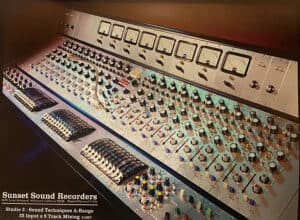
The Sound Techniques console was way ahead of its time, and it sounded great. So much so that people began to book Sunset Studio Two specifically to get Studio Two, the Sound Techniques console, and the reverb chamber on their records.
The list of records done there reads like a who’s who of the late 60s early 70s: The Doors, Alice Cooper, Bonnie Bramlett, Bonnie Raitt, Dave Mason, Earth Wind & Fire, Hoyt Axton, Jackson Browne, Jackson Five, Frank Zappa and the Mothers, James Taylor, Led Zeppelin, Leon Russell, Little Feat, Music Emporium, Ray Manzarek, Ringo Starr, Rita Coolidge, Rolling Stones, Spooky Tooth, Tom Jones... During sessions for Ringo in 1973, Ringo, John and George were in Studio Two, playing at the same time. Paul later came in and did some overdubs—this was the last time all four Beatles were alive and on the same recording, and the closest they ever came to being in the studio all together, all at once.
Making the Plug-in
We went to Sunset in November 2025 specifically to capture the sound of that chamber in that golden moment in time. So, more than getting the Sound of the chamber, we needed the sound of that chamber through the console that would have returned it into the mix, the Sound Techniques A-Range.
Unfortunately, there weren’t a lot of A-Range consoles made; they're all broken up now, but we did manage to get our hands on a single channel module owned by producer Shooter Jennings. That module, a pre-amp with Sound Techniques unique EQ, is alone on the planet, arguably the rarest classic console channel there is. We sampled the room using that, as well as a newer Sound Techniques ZR channel, to give users another sound, and the UREI 1108. We also used eight different mics in addition to the chamber’s usual RCA 44BX ribbons, because why not use Jim Morrison’s mic to pick up the reverb?
On the plug-in, we also provided a Sound Techniques return module, which we custom programmed based on the circuitry of the ST Range console. We modified the EQ a bit, to better suit it to a reverb return, and we added a compressor and a gate, which weren’t on the original.
Why add something not on the original? Because this isn’t a museum piece. It’s got to be functional for producers and engineers right now. Yes, it has the sounds of Sunset Sound, 1967 to 1974, as accurately as possible. But it can do more than that as well. Time does move on.
Early Access to Sunset Sound Chamber One
Our plug-in, Sunset Sound Chamber One, is due out in a few weeks. You can get on a pre-release list here to get early access to it... and who knows what else!
Listening
In keeping with our comparing mixes across the past few weeks, I’ve tried to do that, as well as point out a few things that are typically Sound Techniques or Sunset’s first reverb chamber to my ear.
Ringo - I’m the Greatest
You can hear the punch on the bottom end on this—a hallmark of the Sound Techniques console’s sound.
Led Zeppelin - Stairway to Heaven Sunset Mix
This mix didn’t make the album. It’s overplayed but this is really fun! It’s panned differently; you can really hear the reverb chamber on it. And you can compare it to the final mix here. The arrangement after the guitar solo is really different. In this respect the final mix is better—they really weeded the garden and brought out the drama.
One of my favorite moments in recorded music is when the drums kick in on Stairway to Heaven. I pulled out this moment from the two recordings so you can compare. This isn’t super accurate. Who knows what the heck extra processing is on these things, and the drum mix might be different. At that time it was very typical for the drum kit to be on a stereo pair of tracks, so the drum mix is essentially the same on both records. Listen to the difference in bottom end punch between the Sunset mix here and the Final mix here.
When the Levee Breaks is the only mix on the Led Zeppelin IV album from Sunset Sound and the Sound Techniques console. Whole Lotta Love was also mixed on the Sound Techniques in Studio 2.
Earth, Wind and Fire - I Can Feel It in My Bones
Again, that bottom end thing, and also the separation sounds very Sound Techniques to me.
Frank Zappa - Willie the Pimp
Again, the bottom end and the separation. Sound Techniques mixes from the time have a lot of clarity left to right.
In 1974, 24-track recording was becoming the de facto standard. The Sound Techniques console was set up for 8 track, and would have required a massive retrofit. Tutti pulled it from Studio Two and brought in a Neve 8088. Sound Techniques lost its lease on the building housing their main studio and console manufacturing, and Geoff Frost moved on to software development, becoming very successful at it.
In 2014, American Danny White purchased Sound Techniques and restarted the brand, making consoles as well as rackmount and 500 series modules. It is great-sounding, highly regarded stuff. How Korneff got involved with Sound Techniques is another story, one I’ll write about in a few weeks... because if you’ve not figured it out yet, we’re also making a Sound Techniques channel strip!
That’s all for the obscure history that is New Monday this week.
Warm regards,
Luke