
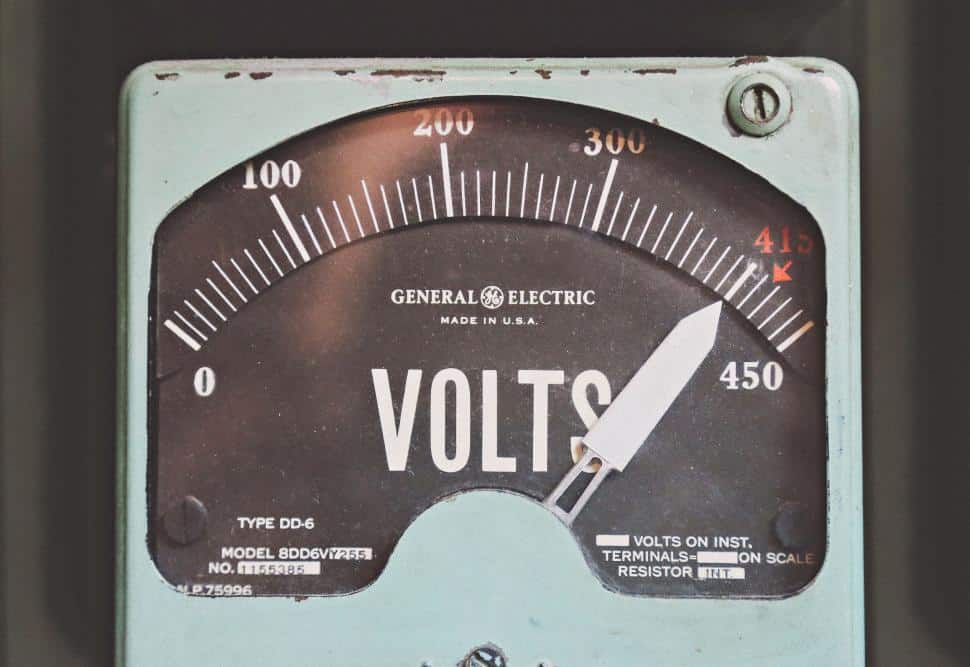
Audio 101: Voltage and Current
Our current analogy for how things work is we have a bunch of guys running around in the circuit, electron guys. They can run down hallways—wires—we can narrow the hallway or put junk in it, which gets in the way and makes it harder for them to pass through a certain point in the circuit, and we call that a Resistor. We can add a Capacitor, which is like a room into which the guys run, get stuck, and then run out while the room on the other side of a partition fills up. We have an Inductor, which is a very crowded hallway that the electron guys have trouble getting through because it's full of other electron guys—kind of the opposite of a capacitor.
Do you notice that all of these components get in the way and impede the travel of the electron guys? Keep that in mind, and that word "impede."
We have to amend our analogy a bit. Guys running around makes it seem like the electrons are whipping up and down empty hallways. Not really. It's more like they're packed together shoulder-to-shoulder, and they give each other a push or a poke. They basically stay still, but they push each other. One guy pushes the next guy that pushes the next. That push travels through the electrons at just below the speed of light. That push is like a message or a signal. The electrons are all basically playing "telephone," transmitting a signal around the circuit.
The push they give each other can be weak, like a little love tap, or strong, like a punch in the head. We can think of this as voltage. The potential strength of the signal (push) is Voltage.
Picture that the power source sends out the initial push, and let's say it is strong. Now, it might go through the electrons and keep its strength, but things could also happen to weaken that push, or perhaps add power to that push. The power source might send a low voltage push, too. There are all sorts of potential voltages that affect the force of the electrons pushing each other.
But there is something else to consider. Voltage is how powerful a push could be, but it also affects the number of guys involved in the pushing. High voltage tends to get a lot of guys pushing. Lower voltages tend to get less guys pushing. But we can also have a lot of guys pushing, or very few.
The amount of guys pushing is called Current. Do you see how current and voltage are different things, but very related?
What electrical circuits basically do is dick around with the force of the push and the number of guys pushing... or, said more maturely, electric circuits manipulate the signal by changing voltage and current.
So, the next question is, how do they change voltage and current?
A big changer of current and voltage is resistance.
Resistance does two things: it limits how many guys can push, and it makes it harder for them to push. So when the signal runs into resistance, the push gets weaker and fewer guys are pushing.
Long wires, like long audio cables running from amplifiers to speakers, offer more and more resistance as the wire gets longer. The push loses energy. Where does that energy go? It turns into heat.
Some materials are better at passing the push along, and they might even have more electrons available to push. Copper is good at this, gold even better. Wood sucks. Things that transmit the push along well are good Conductors. Things that don't transmit the push at all are called Insulators.
Size also makes a difference. Thick, good conductors—like the cables you see on telephone poles—have lots of guys transmitting a strong push. But try to squeeze that strong push through something thin that adds a lot of resistance, and you'll turn that signal into heat—this is how a heater works. And lightbulbs.
So, now we have Voltage, Current, and Resistance. That's the big three. And they all affect each other according to a formula called Ohm's Law. Uh oh! MATH!!!
V means Voltage (the strength of the push). I means Current (the number of guys pushing). R means Resistance (what gets in the way of the guys pushing)
SO...
The push is equal to how many guys are pushing, times what gets in the way of the guys pushing.
V = I x R
And we can flip this formula around:
The number of guys pushing equals how strong the push is, divided by how hard it is to push.
I = V/R
How hard it is to push equals how strong the push is, divided by how many guys are pushing.
R = V/I
NOW... all of this works just fine if the pushes are happening in one direction—if all the electron guys are facing in the same direction. It's easy. You just tap or punch the guy in front of you on the back, and then he does that to the guy in front of him, etc. This works fine with Direct Current, or DC. DC is when the push goes in one direction.
But audio signals switch direction. They're AC, Alternating Current. Current is the amount of guys running around. Direct means they all go in one direction. Alternating means they switch direction.
So, now these guys basically have to stop pushing in one direction, turn and push in the other direction, and then turn and push in the opposite direction, and if we want to hear that, they have to do it between 20 and 20.000 times a second. It's like an insane dance that keeps varying in terms of strength (the push, or Voltage), the number of dancers (Current), how hard it is to push (Resistance) and now, dancers getting confused and mixed up, and not knowing which way to push.
Imagine what a mess this could be: you're dancing along and suddenly everyone in the room turns in a new direction and you do too, but some guys can't turn fast enough before they have to turn back, because as frequency goes up it makes the changes of direction happen faster, and you end up slamming into that guy and you're both pushing on each other's face AND... you're also dancing in something that doesn't conduct well, like peanut butter, so it is harder to move, and maybe there's less room for dancers and less dancers available, or more.
Do you see how that confusion caused by time, which is frequency, adds to the difficulty?
Remember the word "impede" we used at the start? Do you see how Resistance and these timing issues sort of blend together? That's called Impedance. It's resistance but it takes into account the issues caused by Alternating Current and Frequency.
Now we have a different formula, still Ohm's law.
V = I x Z
Z is impedance.
It's like resistance but it's affected by frequency.
That's more than enough for now. I hope you're seeing that this stuff isn't as hard to understand as you might have thought.