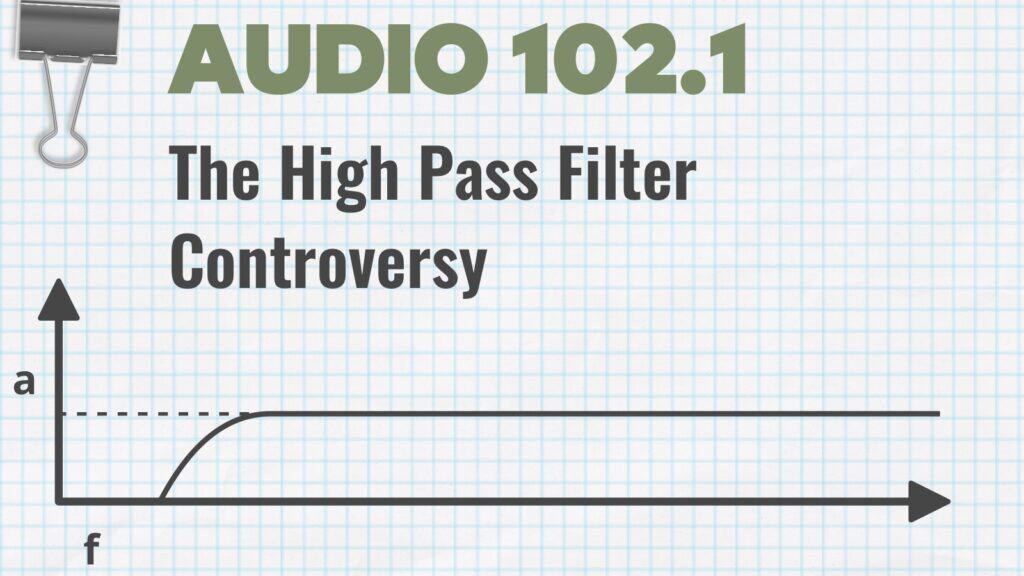
Audio 102-1: The High-Pass Filter Controversy
When I was coming up through studios as a wee small lad with a big mouth, it was standard operating procedure to use high-pass filters all over the place to roll off the bottom end of things. There were high-pass filters on microphones and channel strips—sometimes just a button with a single roll-off at 75Hz, but sometimes it was variable. And we were always switching these things on.
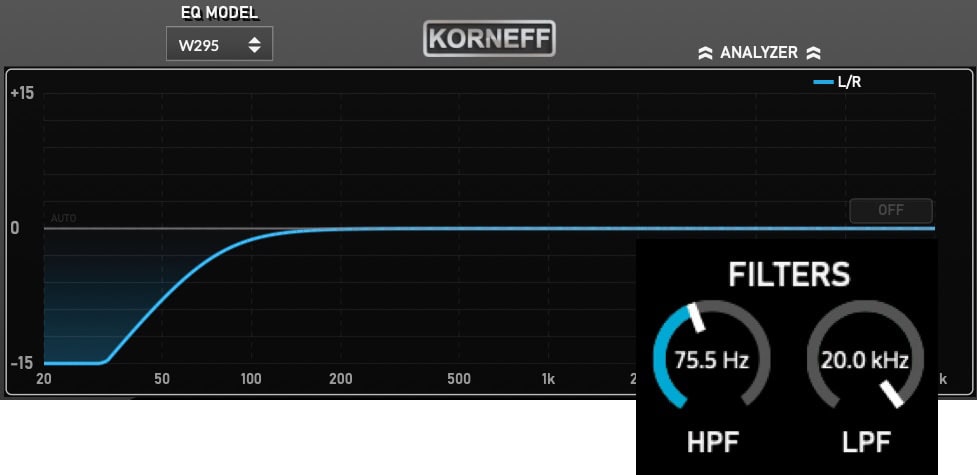
And there appeared to be good reason to. High-passing a vocal mic got rid of the thumps and bumps of feet on the floor and mitigated, somewhat, the low-end buildup caused by proximity effect. Switching it in on guitars took out the subsonic mess, ditto on tom mics and overheads. And besides, THE FAMOUS GUYS were doing it, the guys who knew more than me and had decades of experience.
Now, the FAMOUS GUYS are saying NO!!! Never use high-pass filters! They cause all sorts of phase issues! Guys on audio forums light each other on fire over this issue.
(delivered in a whisper: frankly, I'm pretty sure most guys on forums freaking out over this can't hear the difference, but...)
What is the story here? Has something changed because we’re all digital now? And what is the Useful Truth of the Matter?
Phase and EQ
EQs work because of phase shift. You can think of an EQ as a phase shifter that affects frequency response. How to explain this in a simple way...
A low frequency, say 100 Hz, changes from a peak to a dip more slowly than a 1000Hz changes from a peak to a dip. As frequency goes up, there are more changes from peak to dip across time. Low frequencies change amplitude “less often” over time; high frequencies change “more often” over time.
If you feed that waveform into a circuit, that circuit has to work with the less often/more often, which means that a circuit might respond faster or slower, depending on the frequency. The result is some frequencies get delayed compared to others, and that causes different amounts of phase shift depending on the frequency.
Then, that signal with all the phase shifts gets mixed in with an unprocessed signal. Those shifts can cancel or boost, and that changes the frequency response. Frequencies with a lot of shift affect the amplitude at that frequency more. Now, there aren't literally two separate signal paths in the circuit, one unprocessed and the other phase shifted, but it does kind of work like that in the mysterious world of the electron, and it is useful to think of it like that, as a way of understanding it.
Paul Wolff would kick me under the table over this explanation. Sigh.
All EQs come with phase shift, but the amount depends on the type of EQ or filter.
Why is it especially an issue for high-pass filters?
Earlier, I mentioned a high-pass filter with a frequency of 75Hz. This is the cut-off frequency—the spot where the frequency response drops by 3dB, indicating that’s where the cutting occurs. The cut. It is at that point where the largest amount of phase shift happens. Maximum Phase Rotation. 75Hz is close to an open D string on a bass—the same note you get when you tune down the low E on a guitar to do a dropped D tuning. This is pretty low. The majority of notes and music in a song happen much higher.
But, what if you high-pass the bass down at 40Hz, roll off some of the low end of the guitars down there at 75Hz, and clean up the kick by high-passing it at 30Hz? Now you’ve got 3 areas of maximum phase rotation happening across a bandwidth of about an octave, from 30Hz to 75Hz. All those rotations combine and mix in a tiny and really critical area of the mix. You made all those cuts down there ostensibly to tighten up the low-end, but now it’s a mess, and it becomes murky and weak down there.
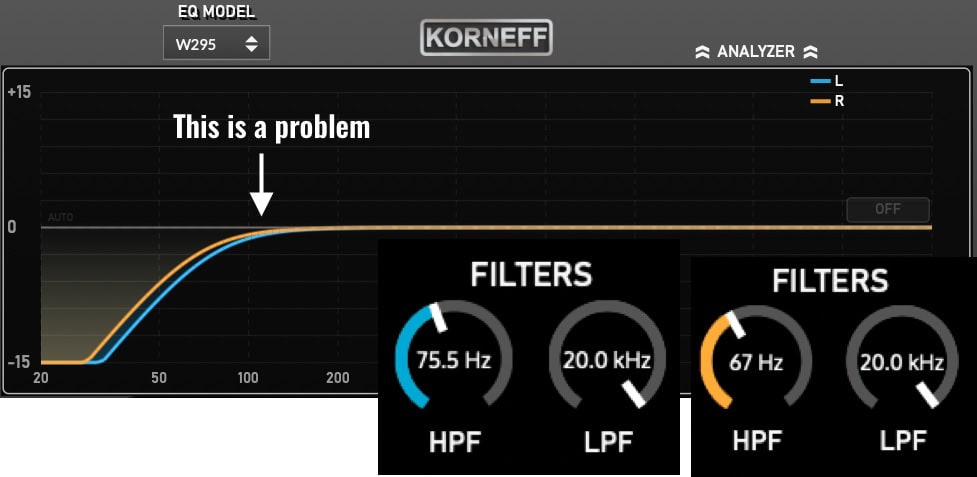
What happens if you start setting the cutoff frequencies higher? Well, then you're moving them into where more of the music is, into where vocals happen, etc. And then they can become more noticeable. A vocal high-passed at 120Hz, a guitar at 150Hz, a piano at 100Hz — now the phase rotation from each of those is happening in a range where there are fundamentals, harmonics, and formants all interacting. It's like dropping a phase bomb in the middle of the music party.
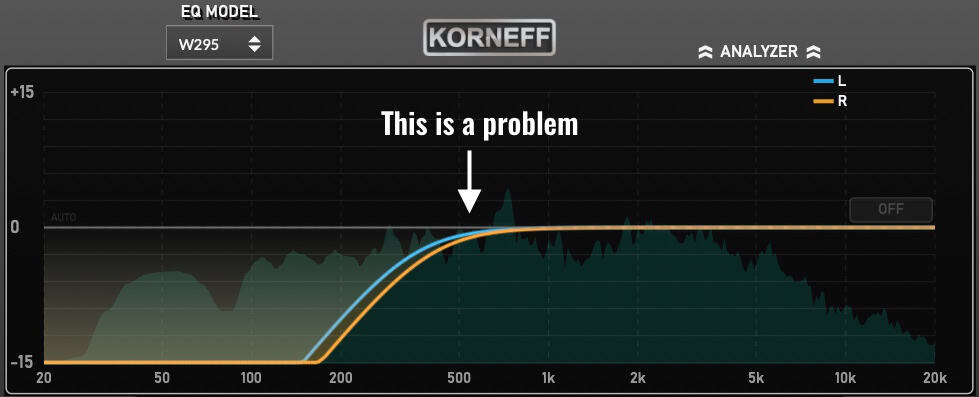
How does this sound? Is it extreme? Is it like when two mics on a guitar speaker are out of phase?
No. It's way more subtle than that. And on one instrument only, it’s unlikely you’ll hear it. But when you mix together a bunch of sources with high-passing, you'll start noticing a thinning or a very slight hollowness. I tend to notice it in situations where I have a bunch of channels up, and then I bring up more, and instead of getting "bigger," the whole thing seems to get smaller. Or something gets weird somewhere. A sound loses presence or clarity or... just dies a little.
The slope of a pass filter exacerbates it. The slope is how many dBs of attenuation happen per octave. A shallow 6dB per octave slope has much less rotation than a steep 24dB per octave slope, which has tons.
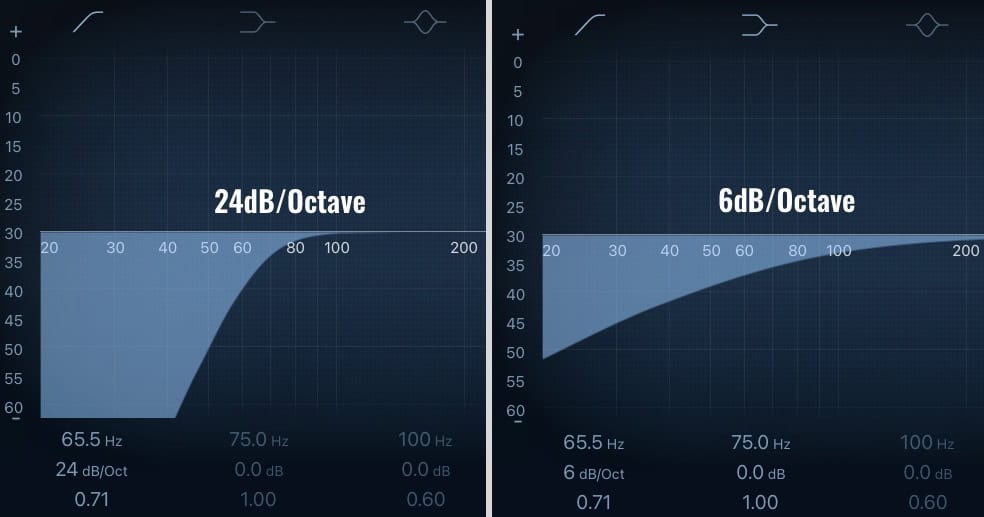
Been using those steep slopes in the bottom end, haven't ya?
Fixing the problem
Nothing is a problem if you like how it sounds. Or if the client likes how it sounds and pays you. I've never heard anyone hum a lack of phase shift or % harmonic distortion. You can get very anal over this stuff.
But let's not be idiots and shitty engineers. Here are some guidelines.
1) Try to avoid steep slopes on pass filters.
2) If you can adjust the frequency of the cutoff, don't set it to something in the middle of the music or where a majority of the notes are clustered. Go lower with a high-pass, or higher with a low-pass.
3) If the lowest note of a part is around 110Hz, set the cutoff at least a half octave below that. So, around 70Hz in this case. That way, the maximum phase rotation is comfortably below the lowest note.
4) Don't use multiple high-pass filters on a track. If you're going to use one, then use ONE.
5) If you have to high-pass a bunch of tracks that are all in a similar frequency area, spread the cutoff frequencies out. One at 30Hz, another at 100Hz and one at 70Hz still sucks, but it's better than everybody at 70Hz.
6) Got a bunch of guitars with a lot of low-end buildup? Don't individually filter them: bus them together and then filter the bus.
7) Use shelves instead of pass-filters to clean up things in the mix. They have less phase shift. In general, the broader and more gentle the action of the filter or EQ, the less the phase issues. A wide Q (bandwidth) parametric setting has less phase rotation than a tight Q parametric setting.
8) Back to the low end: think like, "I'm going to high-pass the bass, use a parametric to boost up what I want in the kick—so like a boost at 30Hz and another 2kHz to get the thump and the click, and then run the kick lower in the mix, and use a low shelf cut to clean up the guitars down there."
9) Remember, the phase issues compound as you add things to the mix, and I mean not only adding channels and tracks, but EQ and effects as well.
10) The more you think about this stuff, the more you'll think you can hear it, the more you'll drive yourself crazy, the less people will like you. Don't die alone over high-pass filters.
Low-pass filtering
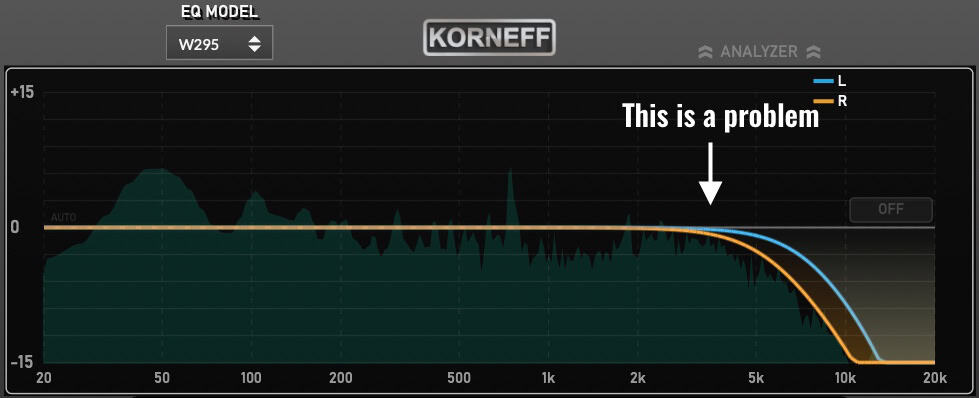
Low-pass filters (which roll off the highs) also cause audible phase anomalies, but it is generally less of a concern. First of all, the tendency is to use high shelves up there rather than pass filters, and shelves cause less issues. Secondly, while there is critical information up there, there aren’t a lot of fundamentals and first harmonics up there, so the effect isn’t as musically detrimental. Now, if you’re doing a lot of pass cuts in the 4kHz to 8kHz, that can definitely cause audible issues and interfere with clarity and definition, but how often does that happen? Never?
Most of our plug-ins have pass filters on them. You can think of them as corrective tools for fixing issues. Our Shure Level-Loc has pass filters on both the input and output. These are better thought of as creative tools, and remember, we have them there at the suggestion of Tchad Blake, who is one of the most creative guys out there.
We’ll be covering more on tech side of filters and equalization in the next few weeks.